 Ptah
How a provider works
The process boundary, the contract and its features, sessions, execution outcomes, locks and the reasons a provider gives, as a provider author meets them.
Edge documents the current development build and may describe unreleased behavior. To use those commands, build Ptah from master. For an installed release, select its version in the header.
A provider owns what Ptah cannot know about an engine: how to connect, how to read its catalog, how to spell a change, how to run it, and how to keep a second writer out. Ptah owns what is the same for every engine: schema sources, comparison policy, the order of a plan, saved plans, migration history rules, and everything a command prints. The two run as separate processes and meet over a versioned gRPC contract. The provider SDK README (latest development source) states the contract field by field; this page gives the model that the README’s sections fit into.
The process boundary
Section titled “The process boundary”Ptah starts a provider as a subprocess of the command that needs it. Before every start, it checks the SHA-256 digest of the executable against the manifest entry or the install record, and after the start it compares the provider ID the process reports with the expected one.
- Trust. A digest detects changed bytes; it does not prove who built them. The process runs with the operator’s operating-system permissions and is not a sandbox.
- Environment. The process receives no environment from the command that
starts it. It sees the bootstrap variables and the
NAME=valueentries the manifest lists, and nothing else, so a provider never readsHOMEor a credential from its environment by accident. - Credentials. A database address, with any credential in it, reaches the
provider in an
Openrequest, never on a command line. - Transport. The SDK runs gRPC over a local listener with mutual TLS, bootstrapped through go-plugin. Standard output belongs to the bootstrap and the transport, and Ptah discards what the provider writes to standard output and standard error, because it can hold a credential.
- Message size. One message is at most 4 MiB in each direction, or 64 MiB
when both sides list
transport.large-messages. - Time. Startup has ten seconds, counted from the launch of the executable
to the end of contract negotiation; a provider that takes longer is refused
with
provider_start_timeout. A call whose work grows with the schema, such as inspection, comparison, planning, rendering or an execution without a statement timeout, runs until the caller’s context ends. Every other call has 30 seconds (runtime.CallTimeout), and provisioning a dev database has ten minutes (runtime.ProvisionTimeout). - Lifetime. The provider starts at the first connection, dev database or plan that needs it and ends with the command. It also watches its parent and exits when the parent dies. Session handles do not survive the process.
A provider written in another language implements the go-plugin control
services and Ptah’s Provider gRPC service; the README’s
bootstrap specification (latest development source)
lists the handshake. A Go provider calls runtime.Serve and gets all of it.
From start to the first call
Section titled “From start to the first call”A command that selects a provider goes through the same steps each time:
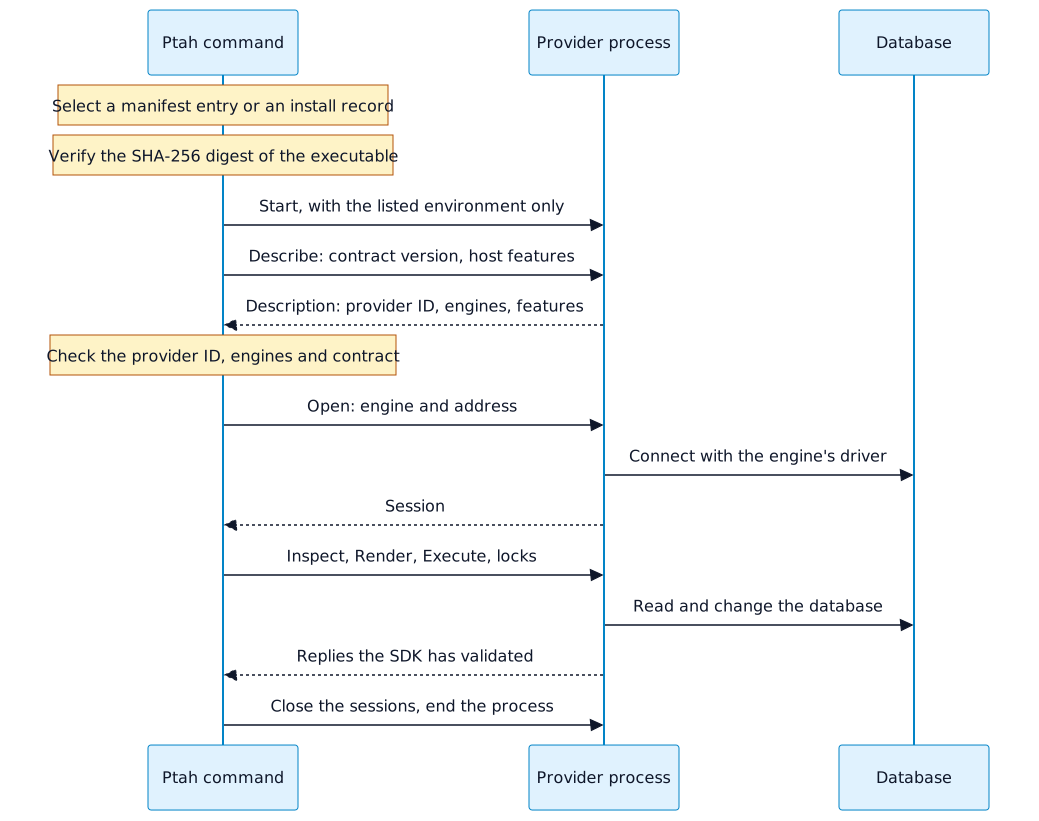
Ptah verifies and starts the provider, negotiates, and calls it over one authenticated local connection.
What to notice: The provider runs with the operator's permissions. A digest proves that the bytes did not change, not who built them.
- Selection. A manifest entry or an installation from
ptah providers installnames the executable. See Which provider serves an engine. - Start. Ptah verifies the digest, starts the process and completes the authenticated handshake.
- Describe. Ptah sends its contract version, the features it acts on, and
the features it requires:
schema.inspect,schema.render,units.executeandsql.analyze. The provider answers with its description, narrowed to what the host can use. - Checks. Ptah compares the provider ID, the engines and their aliases with the manifest, refuses an engine name that the catalog gives to another provider, and registers what the description declares: models, source syntax, query dialect, offline capabilities and scope selections.
- Sessions. Each connection is an
Openwith an engine and an address, and ends withClose. Offline services, such as rendering and comparison, need no session. - End. When the command returns, fails or is interrupted, Ptah closes the sessions and ends the process.
Contract versions and features
Section titled “Contract versions and features”The contract has a major and a minor version. provider.Revision is the
major, and a host and a provider of different majors never talk.
provider.ContractMinor is the minor that the SDK speaks. Each minor adds
vocabulary that an older peer can ignore: a call, a field, an enum value or a
feature.
A provider sets Description.min_contract only when it cannot work at all with
an older host. Left unset, it means the first minor of the major, and the
provider works with every host of that major. A release publishes the same
minimum in ptah-provider.json, so a host can choose a release it can run
before it downloads one. See Package and release a provider.
Features decide what a given host and provider use. Feature names travel in three places:
Description.featureslists the services and behaviors of the provider. Each service inruntime.Serverhas a feature, andruntime.Serverefuses a service without its feature and a feature without its service.Engine.featureslists what one engine offers, such asschema.common-table-identity.v1orsessions.locks. Many services are listed on both.DescribeRequest.host_featureslists what the host acts on.
A two-way feature changes a message that already exists, for example by
adding a reply field. It is used only when the provider and the host both list
it, and provider.TwoWayFeatures() returns every such feature. A service reads
what the host listed with provider.HostFeatures(ctx). The SDK server removes
from a reply what the host did not negotiate, or refuses the reply, so a
provider built from a newer SDK keeps working with an older host. A
provider feature that adds a new call needs no host listing: the host calls
it only when the provider offers it.
The README keeps the table of SDK releases and the contract each one speaks, and names what each minor added; see Contract versions (latest development source).
Sessions and capabilities
Section titled “Sessions and capabilities”An Open reply is a session: an ID, the engine, the database it selected, the
default schema, the server version, the effective identifier rules, the
session’s features and its capabilities. Calls on different sessions may
arrive at the same time, so a provider keeps sessions apart and serializes
what one session must not do twice at once.
A capability is a named fact about the server, such as
ddl_inside_transaction. Presence matters: an explicit false is an
established answer, and an absent key is unknown. Ptah plans with the facts a
session states. An offline command, which opens no session, plans with the
facts the engine states under engine.default-capabilities.
Identifier rules say how names compare: exactly, or with ASCII letters folded. An engine declares them in its description, and a session reports the effective ones. Ptah refuses a missing or unknown rule and never borrows the rules of a built-in dialect.
Execution and uncertainty
Section titled “Execution and uncertainty”Execute receives units, each SQL text or a native operation that the
provider’s own planner produced, and returns an outcome with the number of
consecutive units confirmed applied:
| Outcome | What it confirms |
|---|---|
APPLIED |
Every unit applied. |
NOT_STARTED, NOT_APPLIED |
No unit applied. |
PARTIAL |
A proper prefix applied, and applied_count says how long it is. |
UNKNOWN |
Nobody knows the final effect. A confirmed prefix may still be reported. |
A provider never runs a request again because it carries an ID, and the SDK never retries one. A lost reply, a crash or a cancellation after the request left is an unknown outcome, and Ptah reads the database before it decides anything. Ending the process does not prove that a transaction rolled back.
Transactions are a separate service, sessions.transactions. Listing it does
not establish transactional DDL: the opened session states that as a
capability. Without the service, --tx-mode file and --tx-mode all are
refused before anything runs, unless the session states
ddl_inside_transaction as false, which runs the default mode without a
transaction. A transaction outlives the call that began it, so its lifetime
must not follow that call’s context.
Versioned migrations add three services. sessions.history stores revision
records, sessions.migration-metadata stores the migration log and tags, and
sessions.locks provides the migration lock. The provider owns storage and
atomic writes; Ptah owns ordering, checksums, recovery and repair decisions.
The README sections
Session transactions (latest development source)
and
Revision storage (latest development source)
give the rules.
Locks and receipts
Section titled “Locks and receipts”ptah schema apply and the migration commands take a lock before they read
the target. The provider owns how the engine keeps a second session out; Ptah
owns how long to wait and whether to run.
TryLockmakes one attempt and never waits. It answersACQUIRED,BUSYfor a confirmed refusal, orLOST.- A lock ID is used once. A second request with the same ID gets the first
answer, and a
BUSYanswer lets Ptah try again with a new ID. CheckLockproves ownership now, including the freshness of any lease. An earlierACQUIREDreceipt proves nothing about a later statement.ReleaseLockof an ID that never took the lock fences it, so a lateTryLockacquires nothing. Closing a session releases its locks.- Before execution, history writes and commits, the provider checks every lock that guards the session. A lost lock fences the session for good; release, rollback and close stay available.
Every receipt echoes the scope and the request ID of its request, and the validators refuse one that changes either. Lock, history and transaction results follow this rule, so a reply always says exactly which request it answers.
Reasons a provider gives
Section titled “Reasons a provider gives”A failed call reaches Ptah as its gRPC code. Ptah never shows the status
message, because it is whatever error text the provider passed on, and a
driver’s error can quote an address, a credential or a statement with its
values. Under errors.reasons, the provider adds a reason that Ptah prints
after the code:
provider render failed (InvalidArgument): the tutorial engine stores the column types INTEGER, TEXT, REAL and BLOB onlyA reason is the provider’s promise about the text:
- The provider writes it. It is never the text of an error the provider received.
- It names what failed and why. It never quotes statement text, a value, an address or a credential.
- It is one line of at most 512 bytes of valid UTF-8, with no control
character and no white space around it.
provider.ValidateDiagnosticchecks the shape; nothing can check the content.
runtime.ErrorWithReason(code, reason) builds a failed call. The same rules
apply to the diagnostic of a lock receipt, an execution result and a
transaction result that did not succeed. The SDK server removes every reason
the host did not negotiate and replaces a malformed one with
the provider's reason is malformed and not shown. A cancellation and a
deadline stay the context’s errors.
Some replies carry text of their own, each with its own shape: the reason a read leaves a table out, the reason it leaves roles out, a positioned SQL schema diagnostic, an encoding loss and a cleanup refusal. Each follows the same content rule. The README sections Unread tables (latest development source) and Role scope reasons (latest development source) give their limits.
Where this appears
Section titled “Where this appears”- Build a minimal provider implements the required services, locks and reasons.
- Engines, models and planning covers what the provider declares about an engine and how planning work is divided.
- Understanding the provider boundary follows one YDB example through these rules, from database objects to execution.
- Test a provider proves each rule above with the SDK’s validators.
- Test an executable provider is the operator’s side: selection, manifests and installation.