 Ptah
PtahAtlas schema commands
Inspect, diff, apply, plan, format, clean, and test schemas with the Atlas-style ptah-compat schema verbs.
You want Atlas-style declarative schema work — inspect a live database, diff
schema files, apply or plan desired-schema changes — through Ptah. This page
covers the ptah-compat schema verbs with runnable examples. Every invocation
on this page uses the separate ptah-compat drop-in binary; the install steps
plus the flag translation rules are on the
Atlas compatibility overview.
Command behavior
Section titled “Command behavior”| Atlas-compatible command | Ptah behavior |
|---|---|
ptah-compat schema inspect |
Inspects a live database, a local schema file, a migration directory, or an env:// reference (non-database sources evaluated on the --dev-url dev database) and writes Atlas-shaped HCL, SQL, JSON, or custom-template output, including split/write file exports. |
ptah-compat schema apply |
Diffs a desired-state source (schema files, a database URL, a migration directory, or an env:// reference) against a live database and applies the planned SQL after confirmation. |
ptah-compat schema plan |
Saves the direct schema plan as a fingerprinted local plan file for a later schema apply --plan. |
ptah-compat schema plan lint |
Verifies a saved plan file against the transition, then reports what the migration lint rules find in its SQL. |
ptah-compat schema diff |
Diffs two desired-state sources (schema files, database URLs, migration directories, or env:// references) and prints migration SQL. |
ptah-compat schema fmt |
Formats local .hcl files using HCL canonical layout. |
ptah-compat schema clean |
Plans and applies destructive cleanup of user-owned schema objects. |
ptah-compat schema test [paths] |
Forwards to ptah schema test with Ptah-native YAML test cases. |
ptah-compat schema validate |
Forwards to ptah schema validate: loads the desired state, reports every structural problem found in it without a database, and exits 1 when it finds any. The pinned Atlas community binary v1.3.0 has no such verb, so it is unavailable under PTAH_ATLAS_STRICT_COMPAT. |
ptah-compat schema stats inspect |
Forwards to ptah schema stats: reads a live database and writes one OpenMetrics gauge per schema object kind. See Schema statistics. |
ptah-compat schema push |
Atlas CE boundary stub; the native ptah schema push to any OCI registry is the open replacement. |
Per-verb status detail — Atlas differences, waivers, and the inputs that fail explicitly — is on Atlas-compatible commands.
Schema statistics
Section titled “Schema statistics”ptah schema stats, spelled ptah-compat schema stats inspect on the
Atlas-compatible surface, reads a live database and writes one OpenMetrics
gauge per schema object kind:
# HELP ptah_schema_tables Tables.# TYPE ptah_schema_tables gaugeptah_schema_tables{dialect="postgres"} 12# EOFEvery sample carries the dialect as a label, and --schemas adds the schema
selection as a second one, so several databases can be scraped into one
collector without their series colliding.
What it counts is the schema, and only the schema. There are no row counts, no table sizes and no bloat estimates, because those are properties of the data rather than of the structure Ptah models – a schema that has not changed reports the same numbers however much has been written to it.
A kind Ptah reads nothing for reports zero rather than being left out. A pipeline charting a series needs the series to exist before it can fall to zero, and an absent metric and a zero one mean different things to a collector.
Atlas rejects SQLite for this verb at runtime. Ptah does not: its reader handles SQLite like any other dialect, and refusing would copy a limitation this implementation does not have.
The pinned Atlas community binary v1.3.0 registers no stats verb under
schema, so the verb is unavailable under PTAH_ATLAS_STRICT_COMPAT.
Inspect a schema source
Section titled “Inspect a schema source”ptah-compat schema inspect accepts a --url inspection source and writes
machine-oriented schema output without native Ptah status banners. The default
format is Atlas-compatible HCL. The source is a live database URL, a local
schema file (.hcl, .yaml, .yml, or .sql), a migration directory (a
directory containing atlas.sum), or an env:// reference into the evaluated
atlas.hcl environment.
ptah-compat schema inspect --url "$DATABASE_URL" > schema.hclptah-compat schema inspect --url "$DATABASE_URL" --format '{{ sql . }}' > schema.sqlptah-compat schema inspect --url "$DATABASE_URL" --format '{{ json . }}' > schema.jsonFor a picture instead of a file, --web writes the schema as a local HTML
document and opens it. See Look at a schema as a
diagram.
Inspect output formats
Section titled “Inspect output formats”The Atlas-compatible --format value is a Go-template body. The helper call,
not the helper’s bare name, renders HCL, SQL, or JSON:
| Request | Standard output |
|---|---|
no --format |
rendered HCL |
--format '{{ hcl . }}' |
rendered HCL |
--format '{{ sql . }}' |
rendered SQL |
--format '{{ json . }}' |
rendered JSON |
--format hcl |
literal hcl (3 bytes, no line feed) |
--format sql |
literal sql (3 bytes, no line feed) |
--format json |
literal json (4 bytes, no line feed) |
--format ' sql ' |
literal sql (hex 20 73 71 6c 20, no line feed) |
--format ' json ' |
literal json (hex 20 6a 73 6f 6e 20, no line feed) |
--format ' hcl ' |
literal hcl (hex 20 68 63 6c 20, no line feed) |
The literal rows match Atlas CE v1.3.0 for empty and populated SQLite databases.
Native ptah schema inspect --format hcl|sql|json keeps its rendered
shorthands.
HCL document framing
Section titled “HCL document framing”Single-document HCL output carries no Ptah generated-code marker. A nonempty
HCL document ends with exactly one line feed, whether you use the default
format, the hcl or .MarshalHCL template path, or
--output. An empty SQLite database therefore produces these exact visible
lines, followed by one line feed:
schema "main" {}This is a framing match, not a claim that every populated schema is
byte-identical to Atlas. The modeled-block differences and retained
divergences described below still apply. Native ptah schema inspect keeps
Ptah’s generated-code marker and its existing terminal blank line.
Non-database sources require --dev-url, mirroring Atlas dev-database
normalization: the dev database is reset destructively, the source is
materialized on it (schema files executed, migration directories replayed),
and the result is introspected. Inspecting a file without --dev-url fails
with Atlas’s --dev-url cannot be empty message, and with Atlas’s link to its
dev-database page when the source is SQL or a migration directory. A
--dev-url made of spaces is a value, and fails as Atlas fails it:
sql/sqlclient: missing driver.
One kind of object is not materialized: a role the dev database’s server
already has. The reset empties the dev database, and a role is not in it —
PostgreSQL roles belong to the server — so CREATE ROLE for one of them fails
at SQLSTATE 42710 no matter how clean the database is. Ptah leaves such a role
exactly as the server has it, never altering it, and names the skipped roles on
standard error. A role the server does not have is still created, so the same
document still materializes on a server that has never seen it. This is what
lets an inspected description be fed straight back in against a clean sibling
database on the same server.
ptah-compat schema inspect \ --url file://schema.sql \ --dev-url "$DEV_DATABASE_URL" > schema.hclWhat a URL puts under inspection
Section titled “What a URL puts under inspection”A PostgreSQL-family URL that pins no search_path describes the whole
database — every non-system schema, with its tables — and one that pins a
schema describes exactly that schema. An empty database still describes the
schema it has rather than rendering an empty document, so a consumer walking
.schemas does not break on a database that is merely empty.
# Every schema of the database, `public` and `extra` alike.ptah-compat schema inspect --url "postgres://…/app?sslmode=disable"
# Only `public`.ptah-compat schema inspect --url "postgres://…/app?sslmode=disable&search_path=public"
Every object in the document names the schema that owns it, not the one the
connection happens to be on. That applies to the non-table kinds as much as to
tables: an enum block carries schema = schema.<name>, a function, view,
materialized, domain, composite, range and sequence block each carry
the attribute wherever the object is outside the document’s default schema, and
a column declared against a type in another schema is written against that
schema’s type. Applying such a document therefore rebuilds each object where it
was, and applying it back to the database it describes plans nothing.
PostgreSQL SQL output keeps a foreign key on its owning table when tables in different schemas share a name. Those tables can also use the same foreign-key constraint name. A table in the default schema remains distinct from its schema-qualified namesake.
A schema-limited run refuses a multi-schema HCL desired state
Section titled “A schema-limited run refuses a multi-schema HCL desired state”An HCL desired state that declares more than one top-level schema block is
refused when the run is limited to a single schema, and the message names the
file and every block it counted:
cannot use HCL with more than 1 schema when dev-url is limited to schema "main":2 top-level schema blocks are declared: "main" at schema.hcl:1, "other" at schema.hcl:4A run is limited when the URL that decides its scope names one schema: any
SQLite URL, a PostgreSQL-family URL carrying search_path=<one name>, or a
MySQL-family URL naming a database. --dev-url is checked first and the target
--url second, so the message names the flag that limited the run. A
PostgreSQL-family URL with no search_path limits nothing, and the same
document loads there with both schemas described.
The refusal covers schema inspect, schema apply, schema diff,
schema plan validate and migrate diff, because a desired state the run
cannot reach in full is a desired state no plan can honor. Without it the extra
schemas were dropped and the run reported success:
schema diff --from one.hcl --to two-schemas.hcl answered
Schemas are synced, no changes to be made, and migrate diff wrote a
migration file covering half the document.
The count is of BLOCKS, not of distinct names. A document that opens
schema "main" twice — which is what a directory of per-table HCL files looks
like when every file repeats the schema block — is two blocks, and is refused
on a SQLite dev database for that reason. Declare the schema once, or give the
run a realm-scoped URL.
--schema / -s narrows inspection when the underlying database reader supports
schema scoping, and outranks the URL’s scope: naming a schema that does not
exist renders an empty document rather than falling back to the connection’s
own schema.
A MySQL or MariaDB URL that names no database is the whole server, as the community binary reads it (stokaro/ptah#3789):
- The run describes every user database, each table under its database.
--schemanames databases, and an exclude pattern is realm-relative, as on a PostgreSQL-family URL with nosearch_path.- A foreign key to a table of its own database names the table alone in the JSON format, as the community binary does. One to another database keeps the database, which the community binary drops.
schema apply,schema diffandschema cleanread the URL the same way; see A whole MySQL or MariaDB server.migrate status,migrate applyandmigrate setread it too, and the migrate verbs,schema inspect,schema diffandschema applytake it as a dev server; see Migrate commands.
A URL that names a database reads that database whatever --schema says, as
the community binary does. --format
accepts Atlas-style Go templates with .MarshalHCL, hcl, sql, json,
base64url, mermaid, split, and write. Split-write exports are
supported for HCL and SQL output with the documented Atlas split strategies:
per object (the default: one file per object under per-type directories, with
a main.sql atlas:import entry point for SQL, which reads back as the whole
export), "schema" (one file per schema), and "type" (one file per object
type), plus an optional file-extension argument:
ptah-compat schema inspect \  --url "$DATABASE_URL" \  --format '{{ hcl . | split | write "schema" }}'
ptah-compat schema inspect \  --url "$DATABASE_URL" \  --format '{{ sql . | split "type" | write "schema" }}'
ptah-compat schema inspect \  --url "$DATABASE_URL" \  --format '{{ hcl . | split "schema" ".pg.hcl" | write "schema" }}'
Rendering plans the output files first, and one writer applies the plan:
duplicate output paths, paths that escape the output directory, collisions
between a planned file and a planned directory, and destinations that already
exist as directories fail explicitly before anything is written. Unsupported
split modes and unsafe extension arguments fail at render time. The pinned
Atlas CE binary rejects the split, write, and hcl template functions as
non-community features, so these exports are an open Ptah extension that
follows the documented Atlas behavior.
--exclude accepts repeated or comma-separated Atlas-style glob patterns,
including [type=...] selectors, and removes matching resources from HCL,
SQL, JSON, and custom-template output. Exporter blocks remain an explicit gap.
A type selector sits on the final pattern segment, and [type=schema] may sit
on the leading one: *[type=schema].*[type=table] names every table in every
schema, and app[type=schema].*[type=table] narrows that to one schema. A type
selector on any other segment is refused before a database is contacted.
Ptah applies that literal meaning to every schema source. The pinned community binary applies it to live PostgreSQL inspection but accepts it without filtering tables in a SQLite file diff. Ptah keeps one source-independent selector meaning instead of reporting that the selector succeeded while leaving its tables in the plan. See the measured compatibility difference.
A field selector — the .field suffix behind a type selector — names a
field to subtract while the object it belongs to stays. Ptah honors:
[type=extension].version.commentontable,viewandmaterialized_view.*, which names every field the selected types support
Any other field is refused, by name, before a database is contacted. See Compatibility differences: exclude field selectors for why Ptah refuses these rather than accepting and ignoring them the way the pinned community binary does.
A pattern matches an object under either spelling: its bare name, or its name
qualified by the schema that owns it. Introspection reports an object in the
connection’s own schema with no schema of its own, so the connection default
supplies the qualified spelling — --exclude public.users and
--exclude users remove the same table on a PostgreSQL database URL, and both
subtract it from every side of a comparison, so an excluded object is neither
created nor dropped.
That rule covers every top-level object kind: tables, views, materialized
views, extensions, enums, functions, sequences, domains, composite types and
range types. Each carries the schema that owns it, so --exclude public.mood,
--exclude app.fn_app and --exclude public.positive_int remove exactly the
object they name — including from the DROP list a schema diff or
schema apply plans.
Two kinds have no owning schema and so match by bare name only. Roles are cluster-scoped. Schemas are the top of the tree themselves, and a selector naming one removes it together with everything in it — see Excluding a schema.
The kinds an --exclude subtracts are the same kinds an --include selects.
Sequences, domains, composite types and range types used to be selectable by
--include and invisible to --exclude, so --exclude positive_int left the
domain in the plan and DROP DOMAIN ran on an object the selector was written
to protect.
A sequence that a SERIAL or identity column creates is part of its column,
so neither side describes it as a sequence. A grant on it is still compared,
and it follows the column’s table: --include items manages the grant on
items_id_seq, and --exclude items or --exclude items.id leaves it alone.
A selector can also name the sequence, as items_id_seq or
items_id_seq[type=sequence], and then only the grant on it is kept or
removed. A standalone sequence OWNED BY a column leaves with an excluded table
or column, as --include keeps it with a selected table. schema clean is
stricter about the column’s own sequence, because dropping the table drops the
sequence with it: there a selector that splits the two is refused.
Excluding a schema
Section titled “Excluding a schema”A one-part selector also names a schema, and a schema that matches takes its contents with it:
$ ptah-compat schema inspect --url "$PG_URL" -s public -s app --exclude appschema "public" { comment = "standard public schema"}...schema "app" and every object in it — tables, enums, sequences, views, the
grants that ride them — leave together. That is what the pinned Atlas community
binary v1.3.0 does for the same selector in the same scope: with --exclude app
it plans drops for public only, and removing the selector from that run adds
exactly one line, DROP SCHEMA "app" CASCADE;. --exclude app[type=schema]
names the same schema explicitly.
Ptah offers both the exact catalog spelling and a selector-safe quoted spelling
for a schema name. A case-preserving catalog schema named Sales therefore
matches --exclude Sales and --exclude 'Sales[type=schema]', while sales
and quoted whitespace identities remain distinct.
The two-part spelling keeps meaning what it always meant. --exclude 'app.*'
removes the objects in app and keeps the schema itself, because app is
not a match for the glob app.*. Use the one-part form to protect the schema,
the two-part form to protect only its contents.
Schemas were the last kind that was read and rendered but never offered to the
patterns, which made --exclude app fail in both directions at once: schema apply refused it as a selector that matched nothing, and with the permissive
opt-in set the plan still dropped app’s tables and enums.
An --exclude selector that matches nothing
Section titled “An --exclude selector that matches nothing”A selector that names no object protects no object, and the output cannot say whether that was the schema or the selector. Ptah always says which:
schema inspectandschema diffkeep their exit status and writeWarning: the --exclude selection matched no objects: "<selector>".to stderr. Neither verb changes anything, and stdout stays byte-identical so the CI idiom “does this selection differ?” keeps working.schema applyrefuses with exit 1. It is the verb that carries the plan out, and a selector written to keep an object out of the plan that named nothing leaves the plan free to change it.
A selector counts as matched when it names an object in any state the command filtered. Naming an object that exists on only one side of a comparison is ordinary — that is what a CREATE or a DROP looks like — so only a selector empty on every side is reported.
A selector is only ever called empty by a filter that asked it. That is why
this diagnostic is tied to the coverage above: an object kind that is read but
never offered to the patterns would make every selector naming one of its
objects look empty, and the refusal would then be a hard failure asserting
something false. The same rule covers children of a parent another selector
already removed — --exclude users --exclude users.id names two objects that
both exist, so it is accepted even though the column leaves with its table.
This is a deliberate divergence. The pinned Atlas community binary v1.3.0 exits
0 and prints no diagnostic for --exclude nosuchobject; matching is the floor
rather than the ceiling, and a silent scope failure is the one answer Ptah
declines to reproduce.
Reusing one exclude list across environments where some of the objects are absent is a real workflow, so the permissive behavior stays reachable on this same surface:
$ PTAH_ATLAS_ALLOW_UNMATCHED_EXCLUDE=1 ptah-compat schema apply --url "$PG_URL" \ --to file://schema.hcl --exclude nosuchobjectWarning: the --exclude selection matched no objects: "nosuchobject".It is an environment variable and not a flag because the conformance
cli-surface tier asserts that ptah-compat registers exactly the flags the
pinned binary registers.
It reads like every other boolean PTAH_* variable: unset keeps the refusal, a
valid boolean is honored, and anything else fails schema apply before it reads
the database — including on a run whose selectors all match, so a typo in a
shared environment file stops the next run rather than the next unmatched
selector. See
Boolean environment variables.
Accepting both spellings is looser than the pinned Atlas community binary,
deliberately. That binary reads a pattern relative to the URL scope: on a
database URL only public.users matches, and on a schema-bound URL
(?search_path=public) only users does. Ptah honors both in both scopes.
The extra matches only ever remove more objects from a plan, so the looser
rule cannot turn a protected object into a dropped one.
That looseness applies to objects, not to their children. A pattern names at most a schema, an object and one of the object’s children, and which of the three the first segment fills depends on what the run describes.
On a URL that names a schema (?search_path=public), the schema slot is
filled by the connection and the pattern is read relative to it: users names
the table, users.name names its column, and users.users_name_idx names its
index. A third part has nowhere left to go, and Ptah refuses it, quoting the
pattern as written and naming the one that reaches the same column:
$ ptah-compat schema inspect --url "$PG_URL&search_path=public" --exclude public.users.nameError: too many parts in pattern "public.users.name": this connection is bound to schema "public", so a pattern names object or object.child; write "users.name"The community binary refuses the same pattern and quotes it with the schema
already prefixed, as "public.public.users.name". Same refusal, different
words; see docs/conformance.md.
On a URL that names no schema, the run describes the whole realm and the pattern is realm-relative, so all three slots are addressable and a column in any schema can be named:
$ ptah-compat schema inspect --url "$PG_URL" --exclude public.users.name# table "users" is rendered without its "name" columnThe same pattern is therefore honored on one URL and refused on the other,
which is what the community binary does with it. Every surface that filters a
live connection asks the URL the same question, so schema inspect,
schema diff, schema apply and schema clean cannot disagree about which
scope a pattern is relative to.
The refusal is a usage error rather than a no-op on purpose. A pattern that
deep is almost always an attempt to name a table, and matching it against
columns would answer a question that was not asked by removing a column from a
table the user was trying to keep whole. A pattern too deep for any scope, such
as *.*.*.*, is refused before a database is contacted, so its message carries
no schema prefix.
Parts are counted on the pattern as written, selector text and field suffix included:
*[type=extension].versionand*[type=table].commentare accepted in every scope.public.*[type=extension].versionandpublic.*[type=table].commentare accepted on a realm-scoped URL and refused on a schema-bound one. The community binary answerstoo many parts in pattern: "public.public.*[type=table].comment"; Ptah refuses it too and quotes the pattern as written.*[type=schema].*[type=table]is accepted in every scope: a leading[type=schema]segment fills the schema slot itself, so the connection’s schema is not counted a second time.
Counting the resource glob instead would accept the refused spellings and exit 0 where the community binary exits 1.
How an inspected column type is written
Section titled “How an inspected column type is written”A column read out of a database carries no record of how anyone spelled it, so
inspection decides. A type the Atlas HCL schema models is written bare and
lower case, and every other type is written as a sql("...") call carrying the
server’s own spelling:
column "price" { type = numeric(10,2) }column "prices" { type = sql("numeric(10,2)[]") }column "kind" { type = sql("cube") }The split is not cosmetic. The pinned Atlas community binary refuses a type it
does not model in every spelling except the call — type = USER_DEFINED comes
back as Unknown column.type, and type = "numeric(10,2)[]" as
set field "type": unexpected type string — so a bare or quoted unmodeled type
produces a document that binary cannot read at all. Which names are modeled is
measured against it per dialect by the Atlas CE Oracle job rather than copied
from a table, and the list errs short: wrapping a type that did not need it
round-trips, while leaving one bare that did need it does not.
Arrays always take the call. No array is one HCL type expression, whatever
its element type is, so text[], numeric(10,2)[] and
timestamp(3) with time zone[] are all written as sql(...). PostgreSQL drops
an array’s declared dimensions itself — varchar(100)[10][] is stored and
reported as character varying(100)[] — so the inspected spelling is the
server’s, not the author’s.
A domain is named, not resolved. A column typed by a domain is written with the domain’s own name, including when the domain is built on a type Atlas does not model:
CREATE DOMAIN point3d AS cube CHECK (cube_dim(VALUE) = 3);CREATE TABLE scalars (c_point3d point3d NOT NULL);inspects as type = sql("point3d"). Writing the base type there would apply
back as a bare cube column and take the domain’s CHECK with it, so the
domain name is what survives the round trip (stokaro/ptah#1138).
Blocks the compatibility surface leaves out by default
Section titled “Blocks the compatibility surface leaves out by default”ptah-compat schema inspect omits three top-level HCL block types on
PostgreSQL — extension, sequence, and policy — when nothing else in the
document names the object. The pinned Atlas community binary refuses an entire
schema file that declares any one of them, answering
postgres: extensions are not supported by this version and the equivalent for
the other two. Output a drop-in replacement writes has to be output the tool it
replaces can read back, and one such block costs the whole document.
Nothing is dropped quietly. Every omitted object is reported on standard error, one line each, alongside the other loss diagnostics inspection already writes, and the message names the variable that brings it back:
$ ptah-compat schema inspect --url "$PG_URL" > schema.hclwarning: extensions.pgcrypto: omitted from Atlas-compatible schema inspect output: ... set PTAH_ATLAS_INSPECT_ALL_BLOCKS=1 to keep every block Ptah modelswarning: sequences.order_seq: omitted from ...warning: rls_policies.accounts_all: omitted from ...The omission is scoped as narrowly as the measurement is. It applies to HCL
output on PostgreSQL only: --format '{{ sql . }}' still writes the extension,
the sequence, and the policy, because SQL output is read by a database rather
than by that binary. On SQLite the same three blocks are accepted, so nothing
is omitted there. Every other block Ptah renders — role, function, view,
materialized, trigger, permission — is kept, because that binary drops a
block type it does not model and reads the file anyway.
Native ptah schema inspect omits nothing on this account; see
Inspect a database. Which block types that binary
refuses is re-measured by the Atlas CE Oracle job rather than frozen, so a
construct a later build starts modeling stops being withheld.
One other thing is left out of a PostgreSQL description, and it is not a
compatibility trade: a read defines only the roles the inspected schemas
actually use, on both binaries, because roles are cluster-wide and a
description of one database is not the place to list another tenant’s roles.
That omission is reported on the same stream — note: N roles Ptah manages on this server are not described … — and
PTAH_POSTGRES_INSPECT_ALL_ROLES=1 describes every role Ptah manages again.
Comparison is unaffected either way. See
PostgreSQL roles and grants.
The document says what it does not describe
Section titled “The document says what it does not describe”An omission is a presentation decision, and a presentation decision must not become deletion intent. Before this was written down, inspecting a database and applying the result back to that same database planned to remove what inspection had left out:
$ ptah-compat schema inspect --url "$PG_URL" > schema.hcl$ ptah-compat schema apply --url "$PG_URL" --to file://schema.hcl --dev-url "$DEV_URL" --dry-runDROP POLICY IF EXISTS "p" ON "guarded";DROP SEQUENCE IF EXISTS "order_seq";DROP EXTENSION IF EXISTS "pgcrypto";The standard-error warnings could not prevent that: schema apply is a separate
process, and it reads the file rather than the terminal. So the document now
carries the fact itself, in its header:
// ptah:not-described extension reason=suppressed provenance=defaulted// ptah:not-described policy reason=suppressed provenance=defaulted// ptah:not-described sequence reason=suppressed provenance=defaultedA comparator reading that document has three states for an object instead of two: present, absent, and not described. Only the middle one is a removal.
The attributes after the kind say why the document declines that kind and how the limit was learned:
reasonis one ofnot-inspected,outside-scope,unsupported,suppressedorunresolved.provenanceis one ofdeclared,observed,derived-from-target,derived-from-fact,configured,defaulted,inferredorunavailable.
Neither changes what a comparator may do — a record blocks the same removal with
or without them — and both change what it can tell you when it declines to act.
A directive naming only a kind is a complete record: it says the absence carries
no information and says no more, which is what a line you write yourself means.
The four commands that consume a desired-schema document — schema diff,
schema apply, schema plan, and migrate diff — each resolve that document
separately, and all four now report the database above as synced.
The lines are HCL comments, so they change nothing for any other reader: the pinned Atlas community binary v1.3.0 reads a document carrying them at exit 0 and prints byte-identical output to the same document without them.
Split exports carry the header too, into every member. write puts the
members on a filesystem and whatever reads one of them next is handed that one
file by path, so a record living in a sibling would not be there when it
matters:
$ ptah-compat schema inspect --url "$PG_URL" \ --format '{{ hcl . | split "schema" | write "out" }}'$ head -3 out/public.hcl// ptah:not-described extension reason=suppressed provenance=defaulted// ptah:not-described policy reason=suppressed provenance=defaulted// ptah:not-described sequence reason=suppressed provenance=defaulted$ ptah-compat schema apply --url "$PG_URL" --to file://out/public.hcl --dev-url "$DEV_URL" --dry-runSchema is synced, no changes to be madeAll three split strategies do this — per object (the default), split "schema",
and split "type" — because each of their members is an independently
consumable desired state. Loading several members together is fine: the loader
unions their records rather than intersecting them.
The claim is about the rule this surface applies, not about what one database
happened to contain, so an inspect of a database with no extension at all still
writes the extension line. A document that named only what it left out would
be asserting that the absence of every other extension is authoritative, which
is false the moment the document is applied somewhere else — and that assertion
is the destructive direction.
Removing an object is still something you can ask for. A schema file you
wrote yourself has no coverage header and is fully authoritative, so a
DROP EXTENSION it implies is planned. To mean the omission in a document
ptah-compat produced, delete the line that says otherwise:
$ grep -v 'ptah:not-described' schema.hcl > desired.hcl$ ptah-compat schema apply --url "$PG_URL" --to file://desired.hcl --dev-url "$DEV_URL" --dry-runDROP POLICY IF EXISTS "p" ON "guarded";DROP SEQUENCE IF EXISTS "order_seq";DROP EXTENSION IF EXISTS "pgcrypto";PTAH_ATLAS_INSPECT_ALL_BLOCKS=1 writes none of the three lines above,
because a document that omits no block type describes every one. Native
ptah schema inspect omits none either; its separate generated-code marker is
unchanged. Both still write what the read itself did not describe, such as a
role catalog the server refused, a YDB changefeed, a YDB TTL run interval or a
Spanner change stream: that limit belongs to the description rather than to the
rendering, and a document without it would hand the next plan a silence that
reads as complete. The same directive grammar
is read out of the leading comments of a .sql desired state, spelled
-- ptah:not-described ...; no Ptah surface writes one there, because only
the HCL rendering omits blocks.
A directive naming an object kind, a reason or a provenance the build does not know is an error rather than a line to skip past: a record nothing understands reads as no record at all, and the absence it was protecting would become a removal.
When such a document is the current state
Section titled “When such a document is the current state”schema diff --from file://schema.hcl puts a document on the other side of the
comparison, where its header means something different: not “do not remove
these” but “this side never looked”. That is a reason to distrust the conclusion
“the object is missing” — it is not a reason to discard what --to explicitly
asked for.
So the record withholds a creation only when the creation would need that
conclusion to be true. A statement Ptah renders with IF NOT EXISTS is planned
only when the guard converges every modeled semantic. A guarded sequence meets
that rule. An extension does not: if citext already exists in public, the
following request for extensions succeeds as a no-op and leaves the requested
placement unapplied, so Ptah withholds and diagnoses it when the current side
does not describe extensions:
$ ptah-compat schema diff --from file://schema.hcl --to file://desired.hcl --dev-url "$DEV_URL"Warning: extension "citext" is declared by --to but no change was planned forit: --from does not describe extension objects because a compatibility policyleft them out of the description, so this comparison cannot tell it apart fromone that already exists, and the creation Ptah renders for it cannot safelyconverge from an unknown current state.A statement with no guard — CREATE SEQUENCE for a sequence declared without
if_not_exists, CREATE ROLE, CREATE DOMAIN, CREATE TABLE — would fail the
migration if the object were already there, so it is not planned. It is named on
standard error rather than dropped in silence:
Warning: sequence "public.order_seq" is declared by --to but no change wasplanned for it: --from does not describe sequence objects because acompatibility policy left them out of the description, so this comparison cannottell it apart from one that already exists, and the creation Ptah renders for itcannot safely converge from an unknown current state.For a sequence, adding if_not_exists = true is how you ask for it anyway.
For an extension, the current side must describe extensions so Ptah can verify
the installation schema. Deleting the directive line from --from is how you
assert that side really did look.
A referenced block is kept, and the document says so
Section titled “A referenced block is kept, and the document says so”Suppression never leaves a reference behind. If anything else in the document
still depends on the object — a column default calling nextval on a sequence, a
view body selecting from it, a permission block targeting it, a column whose
type an extension supplies — the block stays, and the reason is reported:
warning: sequences.order_seq: kept in Atlas-compatible schema inspect output because another object in this document depends on it: ...Such a document is not readable by the community binary, and that is not a defect Ptah can fix. Measured on PostgreSQL 17 for
CREATE SEQUENCE order_seq;CREATE TABLE orders (id integer NOT NULL DEFAULT nextval('order_seq'::regclass));that binary’s own inspect emits default = sql("nextval('order_seq'::regclass)")
with no sequence block, and then refuses that output when it is fed back:
pq: relation "order_seq" does not exist. There is no faithful description of a
sequence-backed column default the community binary can read, including the one
it writes itself. Ptah keeps the sequence so the document stays true and stays
readable by Ptah; dropping the column’s default instead would describe a
database that does not exist.
For an extension the question asked is what it supplies, not what it is
called, because the two are usually different words. The isn extension
supplies the type isbn; pgcrypto supplies the function gen_salt. Neither
name appears in a document that depends on it, so a test against the extension’s
own label would omit the block and leave the column behind. Ptah reads the
member list from the catalog (pg_depend against pg_extension) during
inspection and keeps the extension when the document uses any of its types,
functions, relations, operator classes, or operator families.
Two kinds of member name are left out of that list, because neither one is
evidence of anything. A name pg_catalog also supplies keeps resolving with the
extension dropped: citext supplies fifteen of those, among them max,
strpos and replace, and pgcrypto supplies a gen_random_uuid that
PostgreSQL 13 and later supply from core. A function whose name is a SQL keyword
cannot be told from the statement that shares the word: hstore supplies three
functions named delete, and a plpgsql body doing DELETE FROM audit calls
none of them. Either name would pin the extension to a schema that has no
relationship to it, and the community binary refuses any file declaring an
extension block, so a keep that did not have to happen does not shrink the
compatibility win — it removes it.
Neither exclusion can cost a dependency the document really has, and the keyword
one carries the condition that makes that true. Reaching an extension’s overload
instead of the core function takes arguments of that extension’s own type, so a
genuine call to delete takes an hstore value and the type is named on a
column, in a function signature or in a cast. A keyword-named function is
therefore dropped only when the same extension also puts a type in this list
that appears in that function’s signature — the entry that will keep the
extension in its place. An extension supplying merge(text, text) and no type
at all has its only evidence in that name, so the name stays and the block
with it.
Only function names are tested against the keyword list, which the server itself
supplies through pg_get_keywords(). A type, a relation and an operator class
are each named by nothing but themselves, so dropping a keyword-shaped one would
throw away the only evidence there is. The cube extension shows what that
leaves behind — its type and its constructor are both called cube, so a view
saying GROUP BY CUBE(x) still keeps it.
An extension the document may not name
Section titled “An extension the document may not name”Some dependencies have no name to match. PostgreSQL prints an operator class in
a CREATE INDEX only when that class is not the default for the key’s type on
the index’s access method, so with btree_gin installed
CREATE EXTENSION btree_gin;CREATE TABLE t (id integer PRIMARY KEY, n integer NOT NULL);CREATE INDEX t_gin ON t USING gin (n int4_ops);is stored, and rendered back, as CREATE INDEX t_gin ON public.t USING gin (n).
The document holds no token of btree_gin — not its label, and not one of the
support functions its member list holds, none of which anything ever writes. The
extension was omitted at exit 0 and the community binary then refused the
result: create index "t_gin" to table: "t": pq: data type integer has no default operator class for access method "gin". Ptah’s own apply of the same
document failed the same way.
Ptah asks the catalog instead of the text. pg_index.indclass holds the
operator class each index key actually resolved to, so inspection resolves those
classes — and the index’s access method — against pg_depend and records which
extension owns them. The same edge is read for an exclusion constraint, whose
elements print their operators and print an operator class under the same
not-the-default rule: EXCLUDE USING gist (room WITH =, during WITH &&) over an
integer column needs btree_gist and says nothing of it. The keep is reported
like any other, and says which question answered it:
warning: extensions.btree_gin: kept in Atlas-compatible schema inspect output because the catalog resolved an index or constraint in this document to an operator class or access method it supplies: ...The same rule read the other way says when the class is in the document: a
class is printed exactly when it is not the default, so pg_trgm’s
gin_trgm_ops on a text column comes back as
CREATE INDEX w_trgm ON public.w USING gin (txt gin_trgm_ops) and is rendered as
ops = "gin_trgm_ops", or as elements = "txt gist_trgm_ops WITH =" on an
exclusion constraint. That extension is kept as well — omitted, the document
failed to apply with operator class "gin_trgm_ops" does not exist for access method "gin" — but it is kept because the document names something it supplies,
and the report says so:
warning: extensions.pg_trgm: kept in Atlas-compatible schema inspect output because another object in this document depends on it: ...The name question is asked first for that reason. A keep you can find by searching the document is never reported as one you cannot.
Reading USING gin as a reference to btree_gin would answer the same question
wrongly. gin is a core access method that belongs to no extension, and
tsvector, jsonb and array columns all have core GIN operator classes, so
that rule would pin the extension to indexes that do not need it and cost each
of those documents its compatibility. The catalog separates them exactly: a GIN
index over jsonb resolves to nothing an extension supplies, and its document
still comes out with no extension block.
Only an index or constraint the document actually carries counts. Inspection
drops one whose table it does not export, reports it, and writes nothing for
it — a materialized view’s index is the ordinary case, because PostgreSQL
resolves its operator classes in pg_index like any other index while a
materialized block carries none:
warning: index mv_gin: index cannot be rendered because the target table is absent from the exported schemaKeeping the extension for that index would spend the whole document on
something the file does not contain. The community binary refuses any
PostgreSQL file declaring an extension block, and the document applies with
or without it, so the block costs the compatibility and buys nothing.
An extension nothing depends on is still omitted, and the community binary
reads that document at exit 0. Set PTAH_ATLAS_INSPECT_ALL_BLOCKS=1 when the
output has to carry every block regardless.
Two implicit resolutions are not covered, and both were measured rather than
assumed. An extension-supplied implicit cast leaves no catalog handle on the
object that uses it: across the 45 extensions in the postgres:17 image, every
such cast has its own extension’s type on one side (citext, isbn and its
siblings), so naming that type is what keeps the extension, and a cast between
two core types would be a gap. No extension in that image supplies a collation
at all. A primary key or a single-column unique constraint is backed by an index
too, but its operator class is the default for the column’s own type: the
extension-supplied default classes on core types in that image are all gin,
gist or bloom classes and none is btree, so no such constraint can rest on
one without naming the type that carries it.
Get the full description back
Section titled “Get the full description back”$ PTAH_ATLAS_INSPECT_ALL_BLOCKS=1 ptah-compat schema inspect --url "$PG_URL"Every block Ptah models is emitted and nothing is reported as omitted. The
result describes the database in full and the community binary refuses it, which
is the trade the variable exists to let you make. It is an environment variable
rather than a flag because ptah-compat’s flag surface is held to parity with
the pinned binary; see
Capabilities retained deliberately.
Three rules a permission block is written by
Section titled “Three rules a permission block is written by”Each of these is a rule about one position, measured against the pinned Atlas
community binary on the document ptah-compat schema inspect writes. They are
not a promise that every reference in every document resolves — a sequence block
is still refused whatever the reference naming it says, and
the blocks left out by default
names the shapes that binary cannot read at all.
A schema is declared whenever anything in the document references one. That
includes a document with no tables at all: every PostgreSQL database carries
GRANT USAGE ON SCHEMA public TO PUBLIC, so inspecting an empty database
renders a permission block saying for = schema.public and the matching
schema "public" {} beside it. A document that references no schema declares
none.
A grantee is written as a role.<name> reference only where the same document
declares that role block, and as a quoted name otherwise. Grants are children
of the object granted on rather than of the grantee, so excluding roles keeps
every grant to them:
$ ptah-compat schema inspect --url "$PG_URL" --exclude '*[type=role]'permission { to = "app_user" for = table.users privileges = ["SELECT"]}The name is preserved either way — Ptah reads both spellings back to the same
grant, and applying that document issues GRANT SELECT ON TABLE "public"."users" TO "app_user" — so nothing is lost by the quoted form, while a reference to a
block the document does not contain would cost the whole file: the pinned Atlas
community binary refuses it with There is no variable named "role".
A target names the kind of block the document declares for it. PostgreSQL
reports the owner’s implicit privileges on a view exactly as it does on a table,
so a database with a view in it produces permission blocks for the view too,
and those say for = view.<name>:
$ ptah-compat schema inspect --url "$PG_URL"view "v" {  as = " SELECT id\n   FROM t;"}
permission {  to = role.app_user  for = view.v  privileges = ["SELECT"]}
A reference in HCL names a block, and the block type is the first word of it, so
table.v reads as “the v attribute of the table object” and the community
binary refuses the file with This object does not have an attribute named "v".
A materialized view is materialized.<name> for the same reason. The same rule
applies to a trigger’s on, which reaches a view whenever the database has an
INSTEAD OF trigger.
Where the document declares no single block to name, the target is written as a
quoted name instead — for = "v", or for = "other.v" with the schema kept.
Two cases reach it, and neither is exotic. One is a target the document does not
contain, which a selection leaves behind. The other is a label the document
declares TWICE: relations share one namespace per schema, so a realm-scoped
inspect of a database with a view named v in two schemas declares view "v"
twice, and no reference names one of them in particular.
$ ptah-compat schema inspect --url "$PG_URL" --schema public --schema otherview "v" {  schema = schema.other  as = " SELECT id\n   FROM other.t;"}
view "v" {  as = " SELECT id\n   FROM t;"}
permission {  to = role.app_user  for = "other.v"  privileges = ["SELECT"]}
A block is named by its labels, so there is no traversal left that both resolves
and carries the schema: the community binary refuses for = table.other.v and
for = view.other.v alike with This object does not have an attribute named "other", and reads for = "other.v" at exit 0. The short for = view.v does
evaluate there and is still wrong — it means neither of the two blocks, and
reading it back would drop the schema for good. Ptah reads the quoted form back
to the same target, so applying that document issues GRANT SELECT ON TABLE "other"."v".
Select what is inspected with --include
Section titled “Select what is inspected with --include”--include positively selects which top-level resources survive inspection,
with the same selector engine as schema apply and schema diff: --schema names
the universe for schema-owned resources, --include picks resources, and
--exclude subtracts from the result. Database-wide extensions remain visible
regardless of installation placement. An extension-only --include selects
their qualified or bare identities; when a non-extension resource matches, all
extensions ride as support even beside extension selectors. Repeated and
comma-separated values union.
For inspection, an extension-only selection controls which extension identities are rendered. On comparison verbs, an extension omitted from the desired description is not a removal request in support mode; schema-only and extension-only scopes remain authoritative.
Selectors that match nothing render no objects; an empty value carries no selection, so inspection stays unfiltered.
ptah-compat schema inspect --url "sqlite://app.db" --include usersptah-compat schema inspect --url "postgres://localhost/app" \ --schema public --include 'app_*' --exclude app_scratchChild resources — columns, indexes, constraints, triggers, policies, grants —
ride along with their parent and cannot be selected on their own; the
[type=column] spelling fails before any database is contacted. A positional
spelling such as table.column is not refused on its shape — it is
indistinguishable from a table literally named that — so it is carried to the
selection, where an identifier containing a dot can equally be named as
main."my.table", a\.b\.c, or bare. A selection that matches nothing
renders no objects, keeps exit status 0, and reports itself on standard error.
A selection that keeps an object whose dependency it dropped is refused rather
than rendered, so inspected output never references an object it omits:
error: the --schema/--include selection drops objects that selected objects depend on: - table "main.posts" depends on table "main.users" via a foreign key, but "main.users" is not selectedadd the missing objects to the selection or exclude the dependent objectsThe flag is not part of the pinned Atlas CE inspect surface: CE v1.2.0 rejects
schema inspect --include with Error: unknown flag: --include. It is
registered by Atlas, where its behavior differs from
Ptah’s in two measured ways, both documented under
schema inspect --include.
Apply a desired schema
Section titled “Apply a desired schema”ptah-compat schema apply accepts a live database --url and a --to
desired state: one or more local schema file URLs, a file:// directory of
.sql or .hcl schema files read in filename order, one directly connectable
database URL whose live schema becomes the desired state, one migration
directory (a file:// directory containing atlas.sum) replayed on the
required --dev-url dev database, or one env://<attribute> reference
(src, schema.src, url, dev, migration.dir) resolved through the
evaluated atlas.hcl env.
All --to values must be one source kind, and an unsupported scheme fails
before the target database is contacted.
A whole MySQL or MariaDB server
Section titled “A whole MySQL or MariaDB server”A --url that names no MySQL or MariaDB database is the whole server, as on
the community binary. The plan compares the databases as well as the objects in
them:
- A database the desired schema declares and the server lacks is created before
anything in it. Ptah writes
CREATE SCHEMA IF NOT EXISTS, which MySQL and MariaDB read asCREATE DATABASE. - A declared character set or collation that differs is changed with
ALTER DATABASE. One the declaration leaves out is the server’s to choose. - A database the server holds and the desired schema does not declare is dropped with everything in it, after every other statement.
- The server’s own databases, such as
mysqlandsys, are never planned.
--schema limits the run to the databases it names. Use it to apply a file
that describes some of the databases on a shared server:
ptah-compat schema apply --url "mysql://root:pass@localhost:3306/" \ --to file://schema.hcl --schema app --schema auditA database that a declared table is in counts as declared, with or without a
schema block of its own. A table that names no database is refused, because
the server has no database to create it in; the community binary refuses an
HCL table without a schema too. Applied a second time, the plan is empty. The
community binary v1.3.0 plans the table collation and the foreign key index a
second time, measured on MySQL 8.4.11 and MariaDB 11.8.9.
A URL that names one database limits the run to that database. A table the desired schema writes without a database, or with that database’s name, is in it. A table, view, routine, sequence or trigger that the document puts in another database is refused by name before anything is planned, and so is a database the document declares besides the one the URL names:
Error: table "other.u" is in database "other", but the target URL is limited to database "app"; name no database in the URL to reach the whole server, or leave the database out of the nameschema diff refuses the same document beside a --from or --to naming one
database. The community binary runs such a file on the dev database and
refuses it there, Error 1049 (42000): Unknown database 'other'; see
a database outside a one-database URL
for the one file it accepts.
--to may name a whole server too, and that server is the desired schema. A
whole server and one database are refused together, in either order, with the
community binary’s message:
Error: cannot diff a schema "app" with a database connectionA dev database beside a whole server is refused before it is contacted; see
a dev database beside a whole server.
A --dev-url that names no database is a dev server, which schema diff and
schema apply take, and on which schema apply rehearses its plan: see
A whole dev server.
A registry artifact as the desired state
Section titled “A registry artifact as the desired state”atlas://<repository> names a schema artifact held in a registry. The
reference carries no registry host, so it resolves against the namespace
PTAH_ATLAS_REGISTRY names:
export PTAH_ATLAS_REGISTRY=ghcr.io/acme
# oci://ghcr.io/acme/app:latestptah-compat schema apply --url "$DATABASE_URL" --to "atlas://app" --auto-approve
# oci://ghcr.io/acme/app:prodptah-compat schema diff --from "$DATABASE_URL" --to "atlas://app?tag=prod" \  --dev-url "docker://postgres/17/dev"
tag selects a moving tag and defaults to latest; version selects an
immutable one. Naming both is refused, because a tag moves and a version does
not, so a reference carrying both names two different artifacts.
Without PTAH_ATLAS_REGISTRY the reference is refused and the refusal names
what to set, before anything is contacted:
Error: --to "atlas://app": atlas:// registry URLs name a hosted namespace; set PTAH_ATLAS_REGISTRY to the OCI namespace they stand for, or use oci:// with a native Ptah command, a local schema file, a migration directory, a database URL, or an env:// referenceThe artifact is an ordinary OCI one: ptah schema push writes it, the pull
uses ordinary registry credentials from ~/.docker/config.json or a credential
helper, and no hosted service is in the path. PTAH_ATLAS_REGISTRY is a Ptah
extension, so a run under PTAH_ATLAS_STRICT_COMPAT that sets it is refused.
The native spelling for the same artifact is the full OCI reference, accepted
by ptah schema verbs as --schema-file oci://ghcr.io/acme/app:prod. The
atlas:// spelling exists so a project that already names its artifacts that
way keeps working unedited. The same reference forms are accepted in
atlas.hcl by data "remote_schema" and data "remote_dir".
A schema directory is an ordered script, not a set of declarations: Atlas reads one by executing every file in filename order against the dev database. A file that declares an object an earlier file already declared is therefore an error rather than a merge, and Ptah refuses it the same way:
Error: load --to schema: read state from "2_b.sql": table "users" already existsA declaration that carries its own IF NOT EXISTS (or OR REPLACE) is
admitted, because the engine accepts it against an object that is already
there. A later file that only ALTERs what an earlier file created declares
nothing and neither refuses nor contributes.
With --env, Ptah can read env.url, env.src, env.schema.src, env.dev,
env.exclude, env.schema.mode, format.schema.apply, and supported diff
policy from the selected atlas.hcl environment, including local variable
defaults, locals, getenv, file, fileset, format, jsondecode,
jsonencode, and
the supported hcl_schema, sql, external, runtimevar, and
template_dir project data sources. Explicit CLI flags still take precedence.
Ptah reads the current database schema, diffs it against the desired local
schema files, prints the planned SQL, and applies it after interactive
confirmation. Use --dry-run to print the plan without applying it, or
--auto-approve to skip the prompt explicitly.
Which schemas the current side is read at
Section titled “Which schemas the current side is read at”The database is read at the scope the desired state names, so both sides of the
diff cover the same schemas. A desired state that names schemas beyond the one
the connection is on — as an inspected document of a multi-schema database does
— is compared against those schemas too, which is what makes inspecting a
database and applying its own output back a no-op. A desired state that names
only the connected schema reads only that one, so a schema the document never
mentions is never planned for removal. An atlas.hcl environment’s schemas
attribute restricts the universe the same way, and --schema outranks all of
them.
Use --tx-mode=file, the default, to execute the generated plan in one
transaction, or --tx-mode=none to execute statements without transaction
wrapping. Those are the two values Atlas accepts here, spelled exactly; any
other, all and an empty value included, is refused with Atlas’s
unknown tx-mode "<value>". A saved plan applied with --plan also takes
all, where it refuses a -- atlas:txmode directive. With --edit, the planned SQL opens in $VISUAL or $EDITOR
before the plan is shown and approved, and the edited SQL is what gets
applied.
For Atlas script compatibility, schema apply also accepts the hidden
--file/-f alias for local HCL or SQL paths and maps it to the same
local desired-schema loading path as --to. --file and --to are mutually
exclusive.
ptah-compat schema apply \ --url "$DATABASE_URL" \ --to file://schema.sql \ --dry-runExpected output includes:
Planned schema changes:CREATE TABLE "users" ( "id" INTEGER PRIMARY KEY, "email" TEXT NOT NULL UNIQUE, "name" TEXT);An atlas.hcl environment can carry the same inputs:
data "hcl_schema" "app" {  paths = fileset("schema/*.hcl")}
env "local" { url = getenv("DATABASE_URL") dev = getenv("DEV_DATABASE_URL") schema { src = data.hcl_schema.app.url mode { funcs = false } } format { schema { apply = "{{ sql . \" \" }}" } }}ptah-compat schema apply --env local --dry-run--dev-url must match the target database dialect. It is required when
--to is SQL a dev database has to run first — a SQL file, a directory of SQL
files, a migration directory, or an env:// reference to one of those — and
without one the apply is refused before the target is contacted, with Atlas’s
--dev-url cannot be empty. See: https://atlasgo.io/atlas-schema/sql#dev-database.
A database
--to, an HCL file or a directory of HCL files needs none, as on Atlas, and
neither does a YAML schema file: each is already a schema definition.
PTAH_ATLAS_APPLY_WITHOUT_DEV_URL=1 plans a SQL file or directory with no dev
database, which Atlas refuses; native ptah schema apply has no such
requirement.
Before the apply touches the target, the generated plan is rehearsed
on the dev database: Ptah resets the dev database, recreates the target’s
introspected current schema on it, and executes the ordered plan statements —
including SQL edited through --edit — under the same transaction mode as the
target apply. A failed rehearsal refuses the apply and leaves the target
unchanged. The rehearsal runs under --dry-run too, so a dry run cannot report
a plan the real apply would refuse.
On MySQL, MariaDB, and ClickHouse a schema is a database, so a plan
qualified with the target’s schema name would modify the target whichever
connection issued it. Ptah re-scopes those statements onto the dev database
before rehearsing them, so the rehearsal runs entirely inside --dev-url. A
statement naming a third database — one that is neither the target nor the dev
database — cannot be re-scoped and is refused rather than executed somewhere
nobody asked for. On the PostgreSQL family, SQLite, and SQL Server a schema is
a namespace inside the connected database, so the plan is rehearsed exactly as
planned.
The dev database is handed back with nothing the rehearsal put in it, on both
the success and the failure path, so the same --dev-url stays usable by the
next command. The rehearsal empties the whole database when --dev-url pins no
schema, and only the pinned schema otherwise; either way the extensions the dev
database held stay installed.
A dev database that already holds a table is refused before
anything is dropped, as the pinned binary refuses it, whether or not there is a
change to rehearse. schema inspect and schema diff refuse it too whenever a
source is not a database: sql/migrate: connected database is not clean: found table "t" in connected schema, preceded by sql/migrate: taking database snapshot: for SQL and migration directories.
For a SQLite --url, schema apply checks the dev database before it opens
the target, because opening a SQLite file creates it: a refused run leaves no
target file behind. A server --url is contacted first, and an unreachable
one is reported before the dev database. Both orders are the pinned binary’s.
A view, a function, a sequence or anything else the reset drops is refused the
same way, found view "v" in connected schema on PostgreSQL and found view "v" in schema "dev" on MySQL, where the pinned binary accepts it; see
Compatibility differences.
The dev database must not be the target itself or a database-URL --to
desired state (it is reset destructively), must be directly connectable (no
docker://), and must use the same schema scope as the target on
scope-parameterized dialects such as SQL Server. Ptah compares semantic
database identity rather than raw URL text, including percent-encoded SQLite
file URIs, path/symlink/hard-link aliases, network credentials, default ports,
loopback host spellings, and driver-level endpoint/database overrides.
Network URLs with the same dialect and selected database name fail closed
across different endpoints; malformed comparison inputs fail before reset.
A URL comparison cannot see a connection pooler that serves one database under
two names, so after connecting Ptah also asks each server which database the
session selected, and refuses when the dev database is the target or a
database-URL --to. That answer is read before the dev database is reset:
before the plan is rehearsed, and before a migration-directory --to is
replayed on it.
--lock-timeout bounds how long the apply waits for the session advisory lock
(ptah_schema_apply) that serializes concurrent schema applies against one
target database. Strict CE mode first inventories an explicit --schema target
scope; without one, PostgreSQL-family targets inventory the user realm because
desired replay may name schemas beyond the URL’s search_path. This happens
before the lock and before any migration-directory replay on the dev database.
The lock then covers the authoritative target reinspection, planning,
simulation, confirmation, and execution. It is released on every exit path,
including cancellation.
It is a duration and defaults to 10s, as on Atlas. Zero or a negative value
does not wait: the lock is tried once, and a lock another apply holds fails
the run at once, which is how Atlas reads the same values. A value that is not
a duration, an empty one included, is refused by the flag parser with Atlas’s
invalid argument "…" for "--lock-timeout" flag sentence. An elapsed timeout
fails the apply before the locked target reinspection; a strict target-policy
refusal happens before the timeout is consulted. PostgreSQL and YugabyteDB (pg_advisory_lock),
MySQL and MariaDB (GET_LOCK), and SQL Server (sp_getapplock) use real
database locks, and YDB takes a semaphore on its coordination node
ptah_locks.
Every other dialect has no advisory-lock semantics: the apply proceeds without
a lock, and an explicitly passed --lock-timeout prints a note on stderr. The
native ptah schema apply refuses a typed --lock-timeout on those dialects
instead — see Apply a desired schema.
--lock-name replaces the lock name for the run. Two runs serialize only when
they name the same lock, so this is how a Ptah apply coordinates with another
tool on the same database — and equally how it deliberately stops coordinating
with the default. Passing an empty value is refused rather than silently
falling back to ptah_schema_apply. On dialects without advisory locks the
note on stderr names the lock that was not acquired.
--skip-lock acquires no lock at all: no wait, no timeout, and no
serialization against another runner holding the same name. A lock another
process holds is ignored rather than waited on, so concurrent applies can
interleave. It cannot be combined with --lock-name, because there is no lock
to name.
--exclude accepts repeated or comma-separated Atlas-style glob patterns,
including [type=...] selectors. Ptah applies the filter to both the current
live schema and the desired local schema files before planning, so excluded
objects are ignored rather than dropped.
Disabled schema.mode values are mapped to the same resource-exclusion system
for object kinds represented in Ptah’s schema IR. diff.skip.drop_table = true
removes table drops from supported local plans. For non-dry-run PostgreSQL
schema apply plans that actually emit a CONCURRENTLY index statement,
--tx-mode none is required: diff.concurrent_index.create = true for
CREATE [UNIQUE] INDEX CONCURRENTLY, and diff.concurrent_index.drop = true
for DROP INDEX CONCURRENTLY. PostgreSQL rejects either inside a transaction
block. diff.skip.drop_schema is
accepted and type-checked, but changes no plan: Ptah’s schema diff has no
removed-schema list, so there is no DROP SCHEMA for the suppression to omit.
How a column type is compared
Section titled “How a column type is compared”Type spellings are compared after normalization, so a difference that is only
cosmetic — INT against integer, VARCHAR(255) against
character varying(255) — plans nothing, while a change in width, length, or
precision is reported in both directions.
A domain is compared by identity, never by its name’s spelling. A column whose declared type is a PostgreSQL domain agrees only with a desired type that names the same domain; a base type, a different domain, or any other spelling is a change and is planned as one.
A domain’s identity is its schema and its name together, and the name alone is
not it: public.status and other.status are two types, with two CHECK
constraints over possibly different base types. Both halves are read from
information_schema.columns — domain_name and domain_schema — and both are
compared. A desired type that qualifies its schema is held to that schema
exactly. A desired type that does not is resolved through the domain the desired
schema declares by that name, and when nothing declares it the name alone
decides, because which domain an unqualified name reaches is a search-path
question Ptah does not answer for the server. That is why alt.alt_dom and a
bare alt_dom that no CREATE DOMAIN accounts for still name one domain, while
other.alt_dom never does.
Two declarations that share a bare name in different schemas leave an unqualified reference to the name as well: a change between them is reported only when one side spells its schema. That is a known gap rather than a claim — nothing is dropped in that shape, so the cost is drift and not data loss.
The rule exists because normalization matches by substring, and a domain’s name belongs to whoever wrote the schema rather than to any type vocabulary:
CREATE DOMAIN waypoint AS integer CHECK (VALUE > 0);CREATE DOMAIN context AS integer;CREATE TABLE t (id serial PRIMARY KEY, a waypoint NOT NULL, b context NOT NULL);waypoint contains int and context contains text. Compared by spelling,
a column of either would match a desired bigint and text respectively and
no ALTER COLUMN ... TYPE would be planned — while the plan still carries the
DROP DOMAIN ... CASCADE that removing the domain requires, so applying it
would drop the columns and their data instead of converting them
(stokaro/ptah#1138). The same rule is what ptah schema compare reports on the
native surface.
The rule holds in the other direction too. A plain integer column against a
desired schema that declares waypoint and types the column with it is planned
as ALTER TABLE "t" ALTER COLUMN "a" TYPE waypoint, which is what the pinned
Atlas community binary v1.3.0 plans for the same pair. The desired side must
declare the domain for this: a bare type name that no CREATE DOMAIN in the
desired schema introduces is an ordinary type name, and every schema source
Ptah reads carries the declaration alongside the column.
An array is not a domain: its spelling is a type, and it keeps normalizing like
one. format_type writes every array with a trailing [], including an array
of a domain, so the two are told apart by the catalog rather than by the name.
Scope the comparison with --schema and --include
Section titled “Scope the comparison with --schema and --include”--schema/-s and --include positively select what both comparison sides
see, on schema apply and schema diff alike:
--schemanames define the universe for schema-owned resources. Repeated and comma-separated values union deterministically. PostgreSQL extensions remain in both comparison projections regardless of installation placement because they are database-wide capabilities. On PostgreSQL-family targets the names are schema namespaces and unqualified objects belong to the connection’s default schema (public). On MySQL and MariaDB a schema is a database, and because a Ptah connection is bound to one database, only the connected database’s name selects anything. SQLite has the single schemamain.--includepicks top-level resources inside that universe with Atlas-style glob selectors, optionally constrained with[type=...]. Selectable types:table,view,materialized_view,function,enum,extension,sequence,domain,composite_type,range, androle. Repeated and comma-separated selectors union deterministically. Children of a selected table — columns, indexes, constraints, triggers, policies, grants, and seed data — ride along with it, and support objects the selection depends on (enums and other types used by kept columns, sequences owned by kept tables, roles named by kept grants, owning schemas) are retained. A grant on the sequence a serial or identity column of a kept table creates is kept with the table. Extensions skip the schema universe. An extension-only selection such as--schema app --include extensions.citextselects only that database-wide extension. When any non-extension resource matches, all extensions ride as support even when the selection also contains extension selectors. An extension omitted from the desired description is not removed in support mode; schema-only and extension-only scopes remain authoritative. Child-resource selectors such as[type=column]or[type=index], field selectors, and unknown resource types are rejected loudly because Ptah cannot project a partial parent faithfully. A positional spelling such asmain.users.emailis not rejected on its shape: it cannot be told apart from a table literally namedusers.email, so it is carried to the selection and answered there.
Selecting an identifier that contains a dot
Section titled “Selecting an identifier that contains a dot”All three spellings of a dotted name select a table named a.b.c:
ptah-compat schema diff … --include 'a.b.c' # bareptah-compat schema diff … --include 'a\.b\.c' # escapedptah-compat schema diff … --include 'main."a.b.c"' # quoted and qualifiedThe bare spelling used to be refused as ambiguous with schema.table.column,
and the other two were documented as the workaround. Both workarounds still
parse and still select, so nothing written against them breaks; the bare form
works again as well.
A selection that matches nothing
Section titled “A selection that matches nothing”Whether a selector matched is an outcome, not a property of its text.
path.Match treats . as an ordinary character — only / separates — so
every metacharacter that can stand for a dot reaches past a top-level
resource, and all four of these select nothing:
ptah-compat schema diff … --include 'main.users.email'ptah-compat schema diff … --include 'main.users*email'ptah-compat schema diff … --include 'main.users?email'ptah-compat schema diff … --include 'main.users[.]email'So does a plain typo. Each verb answers that condition differently, on purpose:
| Verb | Exit status | Standard output | Standard error |
|---|---|---|---|
schema diff |
1 |
empty | Error: the --include selection matched no objects: "…" |
schema inspect |
0 |
unchanged (no objects rendered) | same warning |
schema apply |
1 |
empty | Error: the --include selection matched no objects: "…"; schema apply would change nothing |
diff refuses because a successful synced result can green-light a CI check
that compared nothing. apply refuses because the empty selection leaves its
target untouched. inspect keeps exit status 0 because an empty read is a
legitimate result, but its warning makes the cause visible.
This is a deliberate choice rather than a matched behavior. Atlas CE
implements no --include flag at all, so there is no measurement to copy for
it. The full Ptah surface keeps that Pro-like capability, including selectors
that match a real dotted top-level name, while refusing only the no-match
outcome on plan-producing verbs. --schema on its own is unaffected here:
narrowing to a schema that holds nothing stays an ordinary answer.
A qualified selector can match a live PostgreSQL extension installed outside
the comparison’s default or selected schema. Identical live placements compare as synced,
creating that placement emits CREATE EXTENSION ... WITH SCHEMA ..., and a
drop remains representable. Comparing two different installation schemas fails
before SQL is emitted because Ptah does not yet plan ALTER EXTENSION ... SET SCHEMA; it never silently moves the extension into the default schema.
--excludeand disabledschema.modevalues subtract from the positive selection afterward. The composition order is fixed: schema universe for schema-owned resources, include selection, then exclusion. Database-wide extensions skip the ownership restriction. An extension-only include filters their identities; a matching non-extension resource carries all extensions as non-removing support even beside extension selectors. Schema-only and extension-only scopes remain authoritative. Exclude selectors still subtract afterward.
The same projection is applied to the current database state and the desired schema, so out-of-scope objects are invisible to the comparison and are never created, modified, or dropped. A selected object that depends on an object the selection dropped — a foreign key to an unselected table, a function calling an unselected function, a view or trigger body referencing an unselected relation, a column using an excluded enum — refuses the plan with an explicit cross-scope diagnostic instead of emitting incomplete SQL:
error: apply --schema/--include to desired schema: the --schema/--include selection drops objects that selected objects depend on: - table "scope_groups" depends on table "scope_users" via a foreign key, but "scope_users" is not selectedadd the missing objects to the selection or exclude the dependent objectsAn --include selection that matches neither the target nor the desired state
refuses the apply, because there is nothing to apply and a synced-schema
message would claim success for work that did not happen. A --schemas
selection that narrows to nothing is not an error. Malformed selectors fail
during validation, before any database is contacted.
--format accepts Atlas-style Go templates over the planned apply changes. The
supported template surface includes the sql helper and .MarshalSQL:
ptah-compat schema apply \ --url "$DATABASE_URL" \ --to file://schema.sql \ --dry-run \ --format '{{ sql . " " }}'Save and execute plan files
Section titled “Save and execute plan files”ptah-compat schema plan is the open local replacement for Atlas’s Pro
registry-gated plan workflow, and it speaks Atlas’s plan-file format.
It computes the same direct schema plan schema apply would generate — from the
--from target database to the local --to schema files — and saves it as a
local plan file. The default format is the Atlas .plan.hcl shape: one
plan "<name>" block with from/to fingerprints and the migration SQL in a
heredoc, named with an Atlas-style UTC timestamp. The written file parses in
Atlas’s own plan reader; the from/to values are Ptah’s sha256
fingerprints, which Atlas parses but cannot verify against its
own base64 hashes (those have no local recipe — in either direction). Without
--save/--output/--dry-run, the plan document prints to stdout, and
--auto-approve is accepted for CLI compatibility.
Ptah fingerprints include named feature objects, attached settings, and the source’s coverage claims. Each feature is bound to its codec owner, version, and model definition. Missing codecs refuse fingerprinting. Plans generated with a different fingerprint format must be regenerated and reviewed before applying them.
An --output path ending in .json writes the native JSON plan
(format_version 1) instead, which additionally records per-statement safety
severity, the dialect, exclude patterns, and the schemas the plan reads beyond
a --from URL pinned to one schema. The .plan.hcl shape has no field for
either of the last two, so a plan that needs them is refused in that shape.
Use --edit to review or rewrite the planned SQL in $VISUAL or $EDITOR
before publication. Ptah preserves statement text and comments, rejects
invalid UTF-8 and empty edited plans, and recomputes safety metadata with the
plan dialect, including MySQL and MariaDB executable comments. --name-format accepts a Go template over .FromHash
and .ToHash; Ptah exposes its digest bytes in the untagged standard-Base64
representation measured from Atlas. --skip-lint is
accepted as an explicit no-op because this command has no lint step; linting a
saved plan file is schema plan lint, below.
Plan publication stages and syncs the complete document before an atomic
rename. Default --save refuses an existing entry without a check/write race;
explicit --output atomically replaces the named entry instead of following a
symlink or exposing a partially written document.
schema apply --plan file://<path> accepts both formats, detected by
content — including .plan.hcl files written by Atlas:
- A JSON plan executes after verifying the live database still matches
the plan’s recorded source fingerprint; a drifted database refuses with a
stale-plan error instead of running reviewed SQL against unreviewed state.
--tois optional. - An Atlas-format plan requires
--to, exactly as Atlas does (the flag "to" is required to verify the provided plan). Its hashes are re-verified with Ptah’s own machinery: the plan is replayed on a dev database starting from the target’s current schema, and the reached state must equal the--todesired state under Ptah’s schema diff before the target is touched. SQLite targets get a throwaway dev database automatically; every other dialect requires--dev-url. A Ptah-written.plan.hclkeeps native sha256 fingerprints, so it gets the stale-plan check too — but the replay runs either way, because the fingerprint shape is public and must never be able to switch a verification off.
The replay is not a sandbox
Section titled “The replay is not a sandbox”Before replaying, Ptah refuses statements that match a deny-list of known
escape constructs — ATTACH/DETACH, VACUUM INTO,
storage-directory pragmas, load_extension, routine bodies and dynamic SQL
calling file-access or dblink functions, LOAD DATA INFILE,
SELECT ... INTO OUTFILE/DUMPFILE, LOAD_FILE, ENGINE=FEDERATED,
CREATE SERVER, INSTALL PLUGIN/COMPONENT, DATA/INDEX DIRECTORY,
COPY ... PROGRAM or COPY with a file path, dblink, postgres_fdw,
file_fdw, the SQL Server xp_/sp_addlinkedserver/OPENROWSET family, and
ClickHouse’s remote table engines:
error: pre-planned migration was refused before it reached the dev database: statement 1 uses ATTACH, which attaches another SQLite database file to the session ...An anonymous DO block is not itself refused — it is the standard PostgreSQL
idiom for idempotent DDL, and a foreign plan is full of them — but what its
body does is scanned like any other statement.
That list is best-effort and not exhaustive, and the replay is not a sandbox. SQL dialects offer many ways to address something other than the connected database — server-side language extensions, foreign-data wrappers, storage-engine options, loadable modules, and engine-specific pragmas and functions — and new ones arrive with new engine versions. Treat the deny-list as a tripwire for honest mistakes and known tricks, not as a security boundary against a hostile plan author.
The practical rule: a --dev-url must point at a database you are willing
to have a foreign plan file execute arbitrary SQL against. Use a disposable
dev database, not one that shares a server, credentials, or filesystem with
anything you care about. The lint is a tripwire in front of it, not a wall
around it.
Where enforcement is real
Section titled “Where enforcement is real”The ephemeral SQLite dev database — the one Ptah creates for SQLite targets, which you never opt into — is the exception, and it does not rely on the lint at all. It is a throwaway file in a private temporary directory, removed when the command exits, and its session is restricted at the engine level before any plan SQL runs:
ATTACHandDETACHare refused by SQLite itself, so plan SQL cannot reach another database file — including the real target.VACUUM INTOis refused by the same restriction, so it cannot write a database copy to an arbitrary path.- Native extensions cannot be loaded.
What the engine does not stop, and the lint therefore still has to: the
storage-directory pragmas (temp_store_directory, data_store_directory —
the first is process-global in SQLite) and PRAGMA writable_schema. The last
one has a consequence worth stating: a plan that sets writable_schema could
edit the dev database’s catalog directly, so the “converges to --to” verdict
is not tamper-proof against the very document being verified. The verdict is a
good-faith check, not an adversarial one.
Ptah verifies the restriction is in force before rehearsing, and refuses to rehearse if it is not, so this cannot fail silently. These are engine refusals: they hold for statements the lint never recognized, including ones built by string concatenation at run time.
The restriction keys on the dev database’s dialect, not on who supplied
it, so an operator-supplied SQLite --dev-url gets exactly the same engine
refusals. For any dialect other than SQLite, none of the above applies: that
database executes the plan’s SQL for real, with whatever credentials and
network reach you gave it.
The verification also runs under --dry-run, so a plan received from someone
else can be checked without committing to apply it.
After every --plan apply with a desired state available, the end state is
verified again on the target — the semantic end-state verification Atlas
performs — and a mismatch fails loudly. There is no flag to disable it.
# Compute and save the plan for review (or --save for ./<timestamp>.plan.hcl).ptah-compat schema plan \  --from "$DATABASE_URL" \  --to file://schema.sql \  --output add-orders.plan.hcl
# Later, execute exactly the reviewed plan; drift refuses loudly.ptah-compat schema apply \  --url "$DATABASE_URL" \  --to file://schema.sql \  --plan file://add-orders.plan.hcl \  --auto-approve
Expected output of the plan step ends with:
Plan saved to file://add-orders.plan.hclIf the target database changed after the plan was saved, apply refuses before touching the target. For a plan with native fingerprints the stale-plan error names both fingerprints:
error: pre-planned migration is stale: the target database schema does not match the plan's source fingerprint (plan sha256:..., database sha256:...); the database changed since the plan was computed, so re-run `schema plan` against the current database and review the fresh planFor an Atlas-authored plan the drift surfaces semantically, and the plan is not applied to the target:
error: pre-planned migration does not converge to the desired state: replaying the plan on the dev database, starting from the target's current schema, left the following schema drift against --to (the plan was not applied to the target):...Review a saved plan
Section titled “Review a saved plan”ptah-compat schema plan lint reads a saved plan file and reports what Ptah’s
migration lint rules find in its SQL. It is the review step between saving a
plan and applying it, and it changes nothing:
ptah-compat schema plan lint \ --from "$DATABASE_URL" \ --to file://schema.sql \ --file file://add-orders.plan.hclAnalyzing planned statements (3 in total):
-- destructive changes detected: -- L3: Dropping table "orders" https://atlasgo.io/lint/analyzers#DS102 -- suggested fix: -> Add a pre-migration check to ensure table "orders" is empty before dropping it
------------------------- -- 4.9ms -- 1 schema change -- 1 diagnosticThe plan is verified first, exactly as schema plan validate verifies it, so a
plan that does not describe the --from/--to transition is refused and
nothing is analyzed. The analysis itself is the one ptah-compat migrate lint
runs over a migration file holding the same SQL, atlas:nolint directives
included.
The command above exits 0. Findings are reported, not enforced: a plan is
something you review and approve, so the report is the product and the exit code
is not a verdict. Set PTAH_ATLAS_PLAN_LINT_FAIL_ON_ERROR=1 where a pipeline
needs it to gate, and an error-severity finding exits 1 with the report still on
stdout.
Read the report rather than the exit code either way. Ptah’s rule set is its
own and does not name every hazard a schema change can carry, so a run printing
-- no diagnostics found is telling you these rules found nothing, not that the
plan is safe. Every run repeats that on stderr, and
Lint rules lists what each rule covers.
Diff schema files
Section titled “Diff schema files”ptah-compat schema diff accepts a desired-state source on each side: one or
more local --from/--to schema file URLs, a file:// directory of .sql or
.hcl schema files read in filename order as an ordered script, one directly
connectable database URL whose live schema is introspected, one migration
directory (a file:// directory containing atlas.sum) replayed on the
required --dev-url dev database, or one env://<attribute> reference (src,
schema.src, url, dev, migration.dir) resolved through the evaluated
atlas.hcl env.
All URLs of one flag must be one source kind. The SQL dialect is pinned by
--dev-url first, then by --from and --to database URLs. With --env,
Ptah can read env.schema.src, env.dev, env.exclude, env.schema.mode,
format.schema.diff, and supported diff policy from atlas.hcl.
A side that is a schema file, a schema directory or a migration directory needs
--dev-url, as on Atlas, and without one the diff is refused before any
database is contacted; two database URLs need none. The message is Atlas’s
--dev-url cannot be empty, with Atlas’s link to its dev-database page when the
first side that needs one is SQL or a migration directory. Set
PTAH_ATLAS_DIFF_WITHOUT_DEV_URL=1 to compare a schema file with a database
without a dev database, as native ptah schema diff does; see
Extension environment
variables.
The dev URL selects the dialect and hosts migration-directory replays. When
--to is a database or a migration directory and --from is a schema file or
directory, the --from side is also created on the dev database and read back,
as on Atlas. Both reset the dev database first, so a database-URL side must not
be the dev database: Ptah compares the URLs, then asks each server which
database the session selected, and refuses before the reset when they match.
Two database URLs that each name no MySQL or MariaDB database compare two whole
servers, databases included, as the community binary compares them: a database
only --to holds is created, one only --from holds is dropped, and a
character set or collation that differs is changed. --schema limits both
sides to the databases it names. A whole server and one database are refused
together, in either order, with the community binary’s message, as
schema apply refuses them.
PostgreSQL-family server namespaces are not migration-managed desired state.
An authored schema "pg_catalog" {} or schema "information_schema" {}, a
CockroachDB schema "crdb_internal" {}, or a Spanner schema "spanner_sys" {}
is refused as a declaration, and so is a Spanner schema its server refuses to
create, such as schema "spanner_app" {} or schema "Public" {}. A database
URL scoped to one of those exact namespaces is observed state instead, but it
is also refused before comparison SQL: catalog objects do not round-trip
faithfully through migration IR, so comparing the converted snapshot could
produce an invalid plan. Quoted lookalikes such as PG_CATALOG and
CRDB_INTERNAL remain ordinary user schemas, except where Spanner’s server
refuses the spelling, as it refuses PG_CATALOG. A migration directory that tries
to create a protected namespace fails during dev-database replay.
ptah-compat schema diff \ -f file://old.hcl \ --to file://schema.hcl \ --dev-url "sqlite://dev.db"With an old.hcl declaring only a users table and a schema.hcl adding a
posts table, expected output includes:
CREATE TABLE "main"."posts" ( "id" INTEGER PRIMARY KEY, "user_id" INTEGER NOT NULL);--format accepts Atlas-style Go templates over Ptah’s local diff report. The
supported template surface includes the sql helper and .MarshalSQL:
ptah-compat schema diff \ --from file://old.hcl \ --to file://schema.hcl \ --dev-url "sqlite://dev.db" \ --format '{{ sql . " " }}'Unsupported schemes — atlas:// registry URLs, docker:// as a desired
state, and anything Ptah cannot connect to directly — fail during validation,
before any database is contacted. Non-Atlas-CE flags such as --tx-mode are
rejected as unknown.
--exclude and disabled schema.mode values filter both local --from and
--to schema files before diffing, and --schema/--include positively
scope both sides with the same selection semantics, composition order, and
cross-scope dependency diagnostics as schema apply (see Scope the
comparison with --schema and
--include).
A diff whose change needs a dialect-specific rebuild plan — for example adding a column to a SQLite table — fails with an explicit error instead of emitting SQL the dialect cannot run in place.
Look at a schema as a diagram
Section titled “Look at a schema as a diagram”-w/--web on schema inspect and schema diff writes the schema as a
self-contained HTML document and opens it with whatever the desktop opens HTML
with. On a diff the document carries the comparison: every table is marked
added, changed or removed, and one both sides agree on is left plain.
ptah-compat schema diff \ --from file://erd-from.sql \ --to file://erd-to.sql \ --dev-url "sqlite://dev?mode=memory" \ --web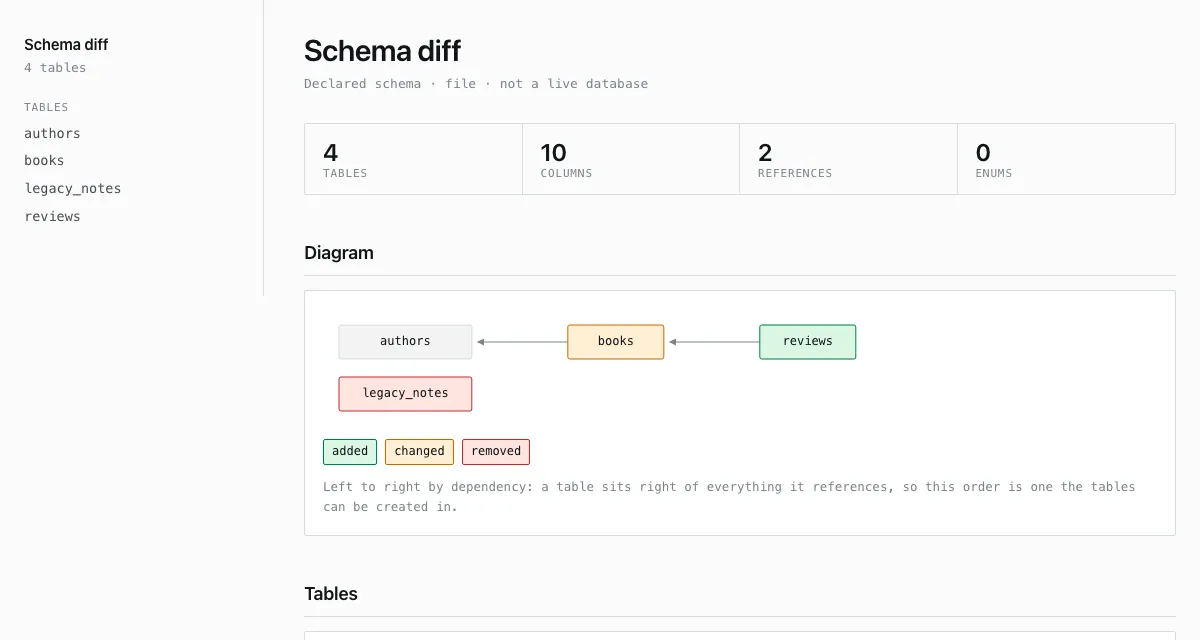
A real `schema diff --web` document for a comparison that adds one table, changes one, and removes one.
What to notice: The color is on the boxes of the dependency diagram, not in a separate list, so the change and what depends on it are read in one picture. The legend names only the marks this comparison produced.
Reproduce this output
ptah-compat schema diff --from file://docs/site/fixtures/product-output/erd-from.sql --to file://docs/site/fixtures/product-output/erd-to.sql --dev-url "sqlite://dev?mode=memory" --webA removed table is in neither --to nor a document rendered from it, so the
diagram is drawn from the end state plus the tables that leave it. That is why
legacy_notes appears at all.
The migration SQL still goes to standard output, unchanged. The document’s path
goes to standard error, so --web composes with a run whose output is being
read:
Schema document written to /tmp/ptah-schema-1699.htmlNothing is published
Section titled “Nothing is published”Atlas’s published CLI reference describes -w, --web as opening the schema ERD
in the browser, which a reader may reasonably take to mean a hosted page. Ptah
writes a local file and opens that. A schema is the shape of somebody’s data, so
the flag that shows it must not be the flag that publishes it. The document
fetches no stylesheet, font, script or image, and a database URL is reduced to
its scheme and host before it is written into the file, so a password does not
travel with a document somebody attaches to a review.
The pinned Atlas community binary v1.3.0 does not register the flag: atlas schema inspect --url ... --web answers unknown flag: --web. So there is no
community behavior this diverges from, and PTAH_ATLAS_STRICT_COMPAT=1 answers
unknown flag here too. migrate lint --web stays unregistered.
When no browser can open
Section titled “When no browser can open”A run that cannot open a browser is not a failed run: the document is the
deliverable and it is on disk before anything is opened. Under CI, or with no
display, the path is printed with the reason nothing opened, and the command
exits 0:
Schema document written to /tmp/ptah-schema-1699.htmlnot opened: CI is setPTAH_SKIP_BROWSER_OPEN=1 asks for the same on a machine that could have opened
one. It is a variable rather than a flag because the conformance cli-surface
tier asserts exact flag parity with the pinned binary. Like every boolean
PTAH_* variable it is strict: a value that is not a boolean is refused before
the command does any work.
The native spelling of the same artifact is ptah schema export --to html --open, which uses the same
renderer and the same opener.
Format schema files
Section titled “Format schema files”ptah-compat schema fmt rewrites local .hcl files into HCL canonical layout:
ptah-compat schema fmt schema.hclClean a database
Section titled “Clean a database”ptah-compat schema clean plans and applies destructive cleanup of user-owned
schema objects. Preview first:
ptah-compat schema clean --url "$DATABASE_URL" --dry-runAgainst a SQLite database containing one users table and one v_const view,
expected output includes:
Planned cleanup changes: 2- DROP TABLE IF EXISTS "users"- DROP VIEW IF EXISTS "v_const"[DRY RUN] No changes were applied.The plan lists the object kinds the target dialect’s cleanup really destroys —
see the per-dialect coverage table.
Rows are ordered alphabetically by object kind; that is a report order, not the
order the statements run in. Scoped cleanup uses a separate deterministic
dependency order for known relationships, including views before tables and
tables before their implicit PostgreSQL SERIAL or identity sequences.
PostgreSQL reads live catalog depth to drop a dependent view or materialized
view before another selected view of the same kind.
Whether a failed scoped plan undoes its earlier drops depends on the server:
- PostgreSQL runs the whole scoped plan in one transaction, so a later
RESTRICTrefusal rolls back earlier drops. - CockroachDB 25 and later commit each schema statement as it runs, because
autocommit_before_ddlis on by default. The plan runs each drop on its own and tries a refused drop again after the others. A plan that still fails keeps the drops that ran before the failure, and the error names them. - YugabyteDB 2026.1 runs the plan in one transaction, but with
yb_ddl_transaction_block_enabledat its default, off, the server does not roll back a drop when the transaction rolls back.
An implicit sequence is not independently selectable: including it without its owning table, or excluding it while the table remains selected, is refused before cleanup mutates the database. Select or exclude the owning table so the child sequence rides with the same decision.
A --url that names no MySQL or MariaDB database is the whole server. The
cleanup drops every user database there and keeps the server’s own databases,
such as mysql and sys. Because the server may be shared, that cleanup is
refused, dry run included, unless
PTAH_ALLOW_SERVER_CLEAN=1
is set; the refusal lists the databases. The community binary drops them without
asking. A foreign key from one database
into another is dropped first. The community binary v1.3.0 drops the databases
in name order instead, and stops with MySQL error 3730 when a database another
one references comes first, measured on MySQL 8.4.11. --include and --exclude are refused at that
scope, because a selector the command ignored would drop what it named; name a
database in the URL to clean part of one.
Format template fields
Section titled “Format template fields”| Command | Format data fields |
|---|---|
ptah-compat schema inspect --format |
.Realm, .Schema, .MarshalHCL, .MarshalSQL, .MarshalJSON, plus hcl, sql, json, base64url, mermaid, split, and write template helpers. |
ptah-compat schema apply --format |
.Changes, .MarshalSQL, plus the sql helper for the planned SQL statements. |
ptah-compat schema diff --format |
.Changes, .MarshalSQL, plus the sql helper for generated migration SQL. |
ptah-compat schema clean --format |
.Env.Driver, .Env.URL, .DryRun, .Applied, .Objects, and .Changes. |
Function entries in .Objects and .Changes also carry .Parameters, and
their .Cmd includes the PostgreSQL signature so overloads remain distinct.
The shared report shape and URL redaction rules are in Atlas-compatible output and redaction.
Next steps
Section titled “Next steps”- Managing migration directories on this surface: Atlas migrate commands.
- Doing direct changes with a native-first flow: Apply schema changes directly.
- Checking the supported
atlas.hclinputs these commands read: Atlas project config.