 Ptah
PtahTrace view column lineage
Run ptah schema lineage to find which base columns each view column and each routine reads, and which tables and columns each routine writes, before dropping or renaming one of them.
ptah schema lineage derives column-to-column dependencies from the view and
materialized-view bodies a schema declares, the columns each routine body
reads, and the tables and columns each routine writes. It answers “what breaks
if I drop this column” before the drop rather than after, and “what changes this
column” alongside it.
The analysis reads a schema source and contacts no database, so it answers before a change is applied. What it cannot attribute it reports as undecided instead of dropping, which is the part of the output a reader has to look at.
Ptah exports lineage as text, JSON, or a Graphviz digraph with --format dot.
The committed fixture produces two resolved view edges and one explicitly
undecided view; download the real text
output, real JSON output, or
real DOT output.
The graph draws an unresolved view dashed and carries its reason as a tooltip rather than leaving it out, and it sorts every node and edge so the same schema renders byte-identically twice — which is what makes it a review artifact a repository can commit and diff.
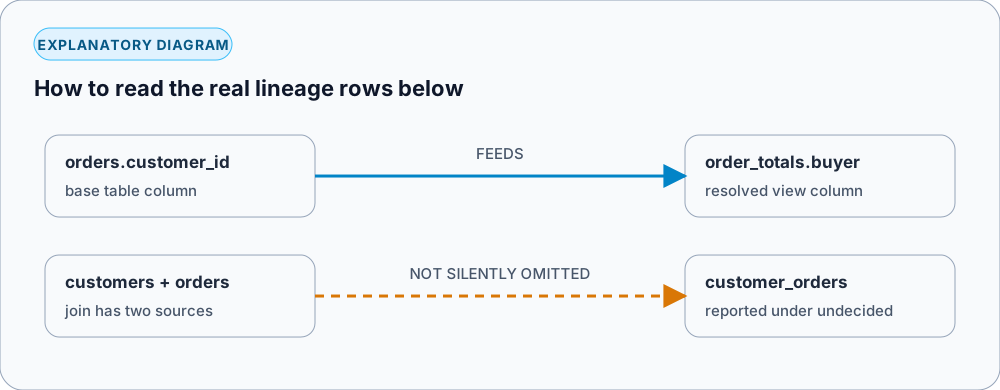
Explanatory diagram—not output from `ptah schema lineage`—of the same fixture. The DOT download above is the real graph; this drawing is here because a rendered picture needs a Graphviz the documentation build does not carry.
What to notice: Resolved edges remain separate from the undecided view, because treating an unresolved join as no dependency would make a destructive change look safe.
Reproduce this output
ptah schema lineage --schema-file docs/site/fixtures/product-output/lineage.sql --dialect sqlite --format jsonPrerequisites: an installed ptah binary (Install Ptah)
and a desired schema. Nothing else — no database, no server.
Starting state
Section titled “Starting state”The examples run against one SQL file holding two tables and two views. Save
this as schema.sql:
CREATE TABLE customers (  id INTEGER NOT NULL PRIMARY KEY,  email TEXT NOT NULL,  country TEXT NOT NULL);
CREATE TABLE orders (  id INTEGER NOT NULL PRIMARY KEY,  customer_id INTEGER NOT NULL REFERENCES customers (id),  total_cents INTEGER NOT NULL DEFAULT 0);
CREATE VIEW order_totals ASSELECT customer_id AS buyer, total_cents AS cents FROM orders;
CREATE VIEW customer_orders ASSELECT c.email, o.total_cents FROM customers c JOIN orders o ON o.customer_id = c.id;
Substitute your own schema source throughout. --root-dir reads
Go annotations instead of a file, and naming both merges
them into one composite desired schema.
Trace the columns
Section titled “Trace the columns”ptah schema lineage --schema-file schema.sql --dialect sqliteExpected output includes:
SOURCE              FEEDS               KINDorders.customer_id  order_totals.buyer  vieworders.total_cents  order_totals.cents  view
1 view(s) not fully resolved:  customer_orders: the FROM clause names more than one source, so an unqualified column cannot be attributed
SOURCE is the base column, FEEDS is the view column that reads it, and
KIND is view or materialized. --dialect selects how the source is
parsed, not a render target, because the same file parses differently per
dialect. The default is postgres.
Read the undecided list
Section titled “Read the undecided list”The second block is what tells you whether the first one is complete. A view
body that resolves only partially is reported under undecided with its
reason, and the whole view goes there rather than the one column that could not
be attributed.
customer_orders above reads two tables, so email and total_cents cannot be
attributed to one of them. A reader who saw only the edge list would conclude
that nothing reads customers.email, and dropping it on that basis would break
the view.
Four shapes land there, each with its own reason line:
| Shape in the view body | Reason reported |
|---|---|
more than one FROM source, such as a join |
the FROM clause names more than one source, so an unqualified column cannot be attributed |
a subquery as the FROM source |
the FROM clause is a subquery, which this analysis does not resolve |
UNION, INTERSECT or EXCEPT |
the body combines queries, which this analysis does not resolve |
| a function call in the select list with no alias | a computed select entry has no alias, so its output column has no name here |
An undecided view does not change the exit code. The run above exits 0.
Trace what a routine reads
Section titled “Trace what a routine reads”A routine reads base columns the same way a view does, and is traced on the
same terms. Save this as routines.sql:
CREATE TABLE customers (  id INTEGER NOT NULL PRIMARY KEY,  email TEXT NOT NULL,  country TEXT NOT NULL);
CREATE FUNCTION customer_emails() RETURNS SETOF TEXTLANGUAGE sql AS $$ SELECT email FROM customers $$;
CREATE FUNCTION touch_customer(target INTEGER) RETURNS voidLANGUAGE plpgsql AS $$ BEGIN UPDATE customers SET country = 'CZ' WHERE id = target; END; $$;ptah schema lineage --schema-file routines.sql --dialect postgresExpected output:
SOURCE           READ BY          KINDcustomers.email  customer_emails  function
SOURCE        READ BY         STATEMENTcustomers.id  touch_customer  update
TARGET             WRITTEN BY      STATEMENTcustomers.country  touch_customer  update
1 routine(s) not fully resolved:  touch_customer: the body is plpgsql: every statement was classified, so the writes are complete; the reads are those of its statements that name one table
Two of those tables say READ BY and are not the same list. The first is a
routine whose whole body is one SELECT, resolved column to column like a view;
the second is a column a statement inside a procedural body reads, and its third
column names the statement. A routine appears in one or the other, never both.
The boundary is the same one the view half draws, in the same place. A body
that is a single SELECT – which is the shape a LANGUAGE sql routine has –
resolves to the columns it reads, through the same reader and with the same four
undecided shapes in the table above.
A procedural body is resolved for what it writes: the tables and columns its
INSERT, UPDATE, DELETE and TRUNCATE statements name, including the ones
inside an IF or a loop. Its reads are not derived, so it is always reported in
undecided as well, and the reason says which of the two happened:
| Reason ends | Meaning |
|---|---|
every statement was classified, so the writes are complete; ... |
the write list above is the whole set |
..., so the writes are not complete; ... |
something in the body could write and was not resolved |
The clause after the semicolon says what was established about the reads, and it depends on the engine rather than on the body:
| Reads clause | Meaning |
|---|---|
the reads are those of its statements that name one table |
reads were derived; a statement with two tables in scope contributed none |
the columns it reads are not resolved, because a declared variable takes precedence over a column of the same name on this engine ... |
MySQL, where the two cannot be told apart |
Four statements land in the second row: one that composes its statement at
run time, which is PL/pgSQL’s EXECUTE, MySQL’s PREPARE and EXECUTE, and
T-SQL’s EXEC of a string or of sp_executesql; a statement whose leading word is not one this analysis knows,
because CALL, MERGE and COPY all write; a TRUNCATE naming more than one
table, refused rather than half-read; and a control-flow statement whose
contents the parser could not split.
Which dialect can answer about reads
Section titled “Which dialect can answer about reads”A read is a column named in a statement, and the danger is a local variable or parameter carrying a column’s name: reporting it as a read of that column would be a wrong answer about the one question this verb exists for. Each engine resolves that ambiguity differently, and the difference is what decides whether reads can be answered at all.
| Dialect | Variable against column | Reads |
|---|---|---|
| the PostgreSQL family | plpgsql.variable_conflict defaults to error, so a body that compiles has no collision |
derived |
sqlserver |
variables carry an @ prefix and cannot collide with a column name |
derived |
mysql, mariadb |
a declared variable takes precedence over a column of the same name | not derived, and the reason says so |
A column a statement assigns to is a write and not a read. In SET country = 'CZ' WHERE id = 1 only id is read; in SET email = lower(email) the column
email is both, and appears in both lists.
Which dialect reads the body
Section titled “Which dialect reads the body”Each engine writes routine bodies in its own procedural language, and each has
its own parser here. --dialect is what selects one; there is no shared parser
to fall back on, because a body read by the wrong one is a wrong answer rather
than a cautious one. A dialect with no routine-body parser reports that, by
name, instead of being analyzed by whichever parser was reachable.
| Dialect | What resolves |
|---|---|
| the PostgreSQL family | every writing statement, including the ones inside an IF or a loop |
mysql, mariadb |
every writing statement at the top level of the body |
sqlserver |
every writing statement at the top level of the body |
| any other | nothing, reported as having no routine-body analysis |
One limit in that table is the body model rather than this analysis. The MySQL
and T-SQL models carry no statements inside a branch, so an IF is reported as
a statement whose contents could not be read – not as a branch that writes
nothing.
That distinction is the whole point of reading the list. A routine reported with writes and nothing else would say its reads are none rather than unknown.
Take the answer as JSON
Section titled “Take the answer as JSON”ptah schema lineage --schema-file schema.sql --dialect sqlite --format jsonExpected output includes:
{ "edges": [ { "from_table": "orders", "from_column": "customer_id", "to_view": "order_totals", "to_column": "buyer" }, { "from_table": "orders", "from_column": "total_cents", "to_view": "order_totals", "to_column": "cents" } ], "undecided": [ { "view": "customer_orders", "reason": "the FROM clause names more than one source, so an unqualified column cannot be attributed" } ]}edges is always present and is [] when nothing resolved. undecided appears
only when at least one view landed there. A check that wants to fail on an
unresolved view reads that key, since the exit code stays 0 either way.
Routines carry their reads, their writes and their undecided list under
routines, so a reader parsing edges keeps parsing exactly the view edges it
always parsed:
{ "edges": [], "routines": { "edges": [ { "from_table": "customers", "from_column": "email", "to_routine": "customer_emails", "kind": "function" } ], "reads": [ { "table": "customers", "column": "id", "by_routine": "touch_customer", "kind": "function", "statement": "update" } ], "writes": [ { "table": "customers", "column": "country", "by_routine": "touch_customer", "kind": "function", "statement": "update" } ], "undecided": [ { "routine": "touch_customer", "reason": "the body is plpgsql: every statement was classified, so the writes are complete; the reads are those of its statements that name one table", "kind": "function" } ] }}Failure modes
Section titled “Failure modes”A completed trace exits 0, whether or not any view landed in undecided. A
usage error exits 2 with one line on stderr. See
Exit codes for the contract.
Limitations
Section titled “Limitations”- The resolvable shape is a select list over a single
FROMsource, with columns named plainly or aliased. The four shapes in the table above land inundecidedinstead. - A routine’s body-wide read resolves only when the body is one such
SELECT. Inside a procedural body, a read resolves per statement, and only where that statement names one table – which is why every procedural routine appears inundecidedeven when its writes are complete. - A write is resolved from the statement that performs it, so it is exact
about the table and about the columns an
UPDATEassigns or anINSERTlists. Which statements are reached depends on the dialect; see the table above. A statement naming the table alone – aDELETE, aTRUNCATE, anINSERTwith no column list – is reported with no column, which means the whole table rather than an unknown column. SET (a, b) = (...)is not read as a column list. The statement goes unresolved instead, because reading the left-hand names as columns would work and reading the right-hand tuple as more of them would not.- An arithmetic expression in the select list with no alias produces an edge
that is wrong rather than an
undecidedentry. For a view declaredSELECT a + b FROM t, the command reports one edge,t.afeeding a view column namedb: the source is the first identifier in the expression, and the target names a column the view does not have. Nothing reportst.b, which the view reads. Alias the expression —SELECT a + b AS total— and both edges resolve correctly. - There is no way to ask about one column or one view. The whole graph is written and the caller filters it.
- With neither
--root-dirnor--schema-file, the working directory is scanned for Go annotations. In a directory that holds none, the run reportsNo view or routine columns to trace.and exits0, which reads the same as a schema with no views. Name the source.
Trace a live database
Section titled “Trace a live database”--db-url traces the schema a server reports instead of one a file declares,
which is how the same question is asked about a database nobody has a
declaration for:
ptah schema lineage --db-url "postgres://user:pass@localhost/app" --schemas publicThe dialect comes from the server rather than from --dialect: a lineage traced
against a live database is about that database, and a routine body is read by
its own engine’s parser.
--schemas narrows what is read, the same way it does for
ptah db read. Everything below applies
unchanged – the resolvable shapes, the undecided list and the JSON document are
the same whether the schema was declared or read back.
Exact reference
Section titled “Exact reference”Run ptah schema lineage --help for the flag set with its environment
variables. Column lineage
places the verb in the native tree, and
Exit codes carries its row.
Next steps
Section titled “Next steps”- Ready to make the change the trace cleared? Apply directly.
- Want the whole schema drawn rather than one dependency? Visualize the schema.
- Counting what the database holds instead? Count schema objects.