 Ptah
PtahInference migrations
What Ptah does with the vectors an application searches, and whether this feature applies to your system.
If your application stores embeddings in PostgreSQL or YDB and you need to change the model that produced them, this area is for you.
Changing an embedding model means every vector in the table has to be computed again. That is not a schema change. The column type may not move at all, and yet none of the values in it is usable afterwards, because a vector produced by one model cannot be compared with a vector produced by another. Ptah manages that rewrite: it builds the new set of vectors beside the old one, checks the result, and switches your queries over when you say so.
Is this for you?
Section titled “Is this for you?”Read on if all of these are true:
- your data lives in PostgreSQL with the pgvector extension, or in YDB;
- your application searches by vector similarity;
- something about how those vectors are produced is changing — the model, its parameters, or the text you feed it.
This feature is not for you if you are looking for a way to serve a model, run one on a GPU, store models, or route application traffic. Ptah does none of those. It manages the database state around inference and nothing else.
Who does what
Section titled “Who does what”Four components are involved, and keeping them apart is the fastest way to understand everything else here.
| Component | Responsibility |
|---|---|
| Ptah | Plans, builds, verifies, activates, rolls back, and retires persistent inference state |
| Embedding provider | Converts the configured input into a vector |
| PostgreSQL with pgvector, or YDB | Store source data, vectors, metadata, and indexes |
| Your application | Creates and updates source rows, produces query vectors, and reads the active generation |
Ptah never produces a vector itself. It reads rows, builds the text to send, calls the endpoint you configured, and writes what comes back. If your endpoint is unreachable, Ptah stops and says so; it has nothing of its own to fall back on.
What a migration looks like
Section titled “What a migration looks like”You describe the change in a file — the source rows, the model, where the vectors go — and then run a sequence of commands. Each one is a decision you take separately:
ptah inference plan # what would happen, and where each answer came fromptah inference prepare # create the target column and the bookkeeping around itptah inference backfill # embed the source into the new generationptah inference catchup # process what changed while the backfill ranptah inference index # build the vector indexptah inference verify # the checks a cutover rests onptah inference cutover # make the new vectors the ones queries readNothing here is implied by anything else. A finished backfill does not mean the new vectors are correct. A passing verification does not move your queries. A completed cutover does not throw the old vectors away.
Two commands exist for what comes after: rollback puts the previous vectors
back if they remain eligible, and retire destroys an inactive generation
when it is no longer an eligible rollback target.
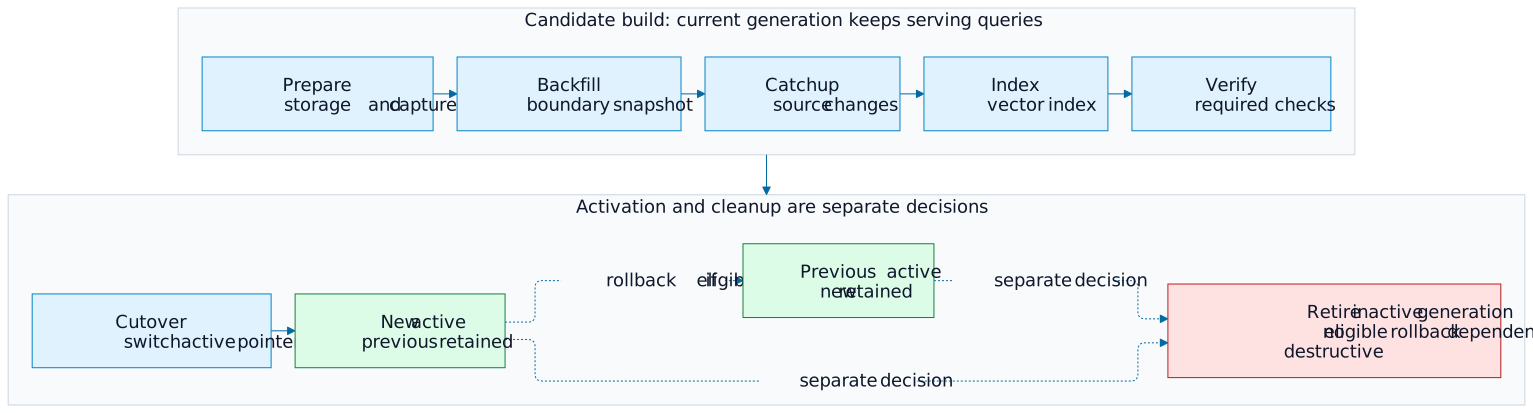
Build and verify a candidate before switching the active pointer.
What to notice: Rollback requires an eligible previous generation. Retirement is separate and refuses active generations and eligible rollback targets.
Where to go next
Section titled “Where to go next”- New to this? Quick start runs one migration end to end against a throwaway database.
- Want the ideas first? Start with Embeddings and inference state.
- Changing a model on a table your application is writing to? That is Migrate a live table.
- Something went wrong? Troubleshooting.
What is supported today
Section titled “What is supported today”PostgreSQL with pgvector or YDB, and an embedding endpoint that speaks the
OpenAI-compatible /v1/embeddings API. No other database engine and no other
provider API. On YDB the consistency mode is immutable, because the outbox
needs row triggers YDB does not have.
Support and limitations is the exact
list, including what Ptah cannot check for you.